

How CAD/CAM Is Redefining Restorative Dentistry
Digital scanning, advanced materials, 3D printing, and artificial intelligence enable CAD/CAM to provide efficient, same-day restorative care.
Computer-aided design and computer-aided manufacturing (CAD/CAM) technology has emerged as one of the most influential innovations in restorative dentistry. With its use expanding dramatically, CAD/CAM is now routinely used for the fabrication of inlays, onlays, veneers, full-coverage crowns, fixed dental prostheses, implant-supported restorations, removable prostheses, and orthodontic appliances. CAD/CAM is no longer a niche technology but an integral component of modern practice, with applications extending across routine and complex restorative care.
Digital Workflow
CAD/CAM describes a process in which clinical information is captured, digitized, manipulated using specialized software, and ultimately converted into a physical restoration.1 This digital workflow replaces several traditional steps, including elastomeric impressions, stone models, articulation, and many laboratory-dependent fabrication stages.
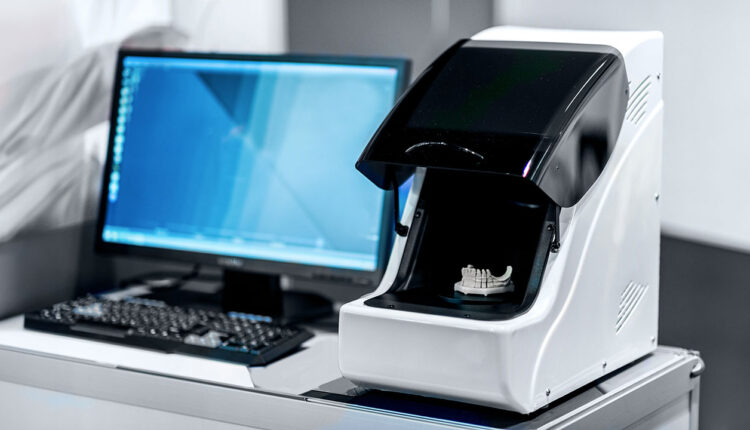
The CAD/CAM process is broadly divided into three key stages. First, data acquisition i s performed through intra- or extraoral scanning. Modern intraoral scanners capture the geometry of prepared teeth and surrounding structures using noncontact optical systems, typically based on light-emitting diode technology.2 Light is projected onto the tooth surface and reflected back to sensors, generating a three-dimensional (3D) digital representation of the clinical situation. Currently, nearly half of practitioners use intraoral scanning, which facilitates the process of digital crown fabrication.3
Second, digital data are processed using CAD software. This software allows the clinician or trained auxiliary to define margins, design restoration contours, adjust occlusion, and evaluate proximal contacts in a virtual environment. Many platforms incorporate automated design proposals based on tooth libraries and occlusal schemes, which can then be refined based on clinical judgment and patient-specific considerations.4 This stage offers significant control over restorative outcomes while reducing dependence on external laboratory communication.
The final stage involves manufacturing the restoration through subtractive milling or additive manufacturing (3D printing). Although milling has dominated the field for many years,5 3D printing is now becoming the method of choice for chairside restorations, offering high accuracy, predictable material properties, and reliable marginal adaptation. 3D printing decreases material waste, provides unlimited geometric reproducibility, reduces the presence of microcracks in the restoration, lowers costs, decreases treatment delays, and offers personalized treatment. The clinical use of 3D printing has created versatile applications that streamline digital workflow. Technological advancements have also paved the way for the integration of new dental materials into dentistry.6 With both methods, a streamlined workflow enables same-day restorative care across many clinical situations, reducing treatment time and improving patient acceptance.
Material Utilization
The rapid adoption of CAD/CAM technology has been closely linked to advances in restorative materials. Current systems support metals, ceramics, zirconia, and resin-based materials.7 However, ceramic and zirconia restorations account for the majority of CAD/CAM-fabricated prostheses in general practice.
Glass-ceramic materials, such as lithium disilicate and lithium silicate ceramics, possess a biphasic structure, with crystalline particles dispersed within a glass matrix. This microstructure provides a favorable combination of flexural strength, fracture resistance, optical properties, and adhesive bonding capability.8 These characteristics make glass ceramics particularly well suited for single-unit restorations in both anterior and posterior regions, where esthetics and strength are equally important. Their compatibility with adhesive cementation further enhances retention and marginal seal.
Zirconia, in contrast, is a polycrystalline ceramic with exceptional mechanical strength and fracture toughness. While traditional zirconia has been associated with limited translucency and weaker adhesive bonding, its strength makes it an excellent choice for frameworks, copings, and long-span fixed dental prostheses.9 Recent developments in translucent and multilayer zirconia have expanded its use into more esthetically demanding indications, although material selection should continue to be guided by occlusal load, span length, and esthetic requirements.10 It is interesting to note that because the term ceramic is defined as a material that is predominantly composed of ceramic, the roughly +70% ceramic filler in resin-based blocks has allowed them to be classified as permanent ceramic restorative materials.3
Resin-based materials, including resin composites, polymethyl methacrylate, and nano-ceramics, are also compatible with CAD/CAM workflows, especially with 3D printing, however, initially long-term wear resistance and color stability were inferior to ceramic alternatives.11 Over time, the materials have been perfected and 3D printing has evolved to become a well-accepted modality and appears to becoming the preferred method of fabrication in the dental office.
Metal frameworks fabricated via CAD/CAM, such as cobalt-chromium alloys and titanium, demonstrate mechanical properties that are often superior to those produced through conventional casting techniques.12 Digital fabrication improves consistency, fit, and reproducibility, reducing the variability associated with manual laboratory processes.
Regardless of material selection, surface quality is a critical consideration. Machined restorations may exhibit surface roughness that can contribute to plaque accumulation and microbial adhesion if not properly finished.13 Polishing or glazing protocols should therefore be incorporated into clinical workflows to optimize surface smoothness and promote long-term periodontal and peri-implant health.
Artificial Intelligence
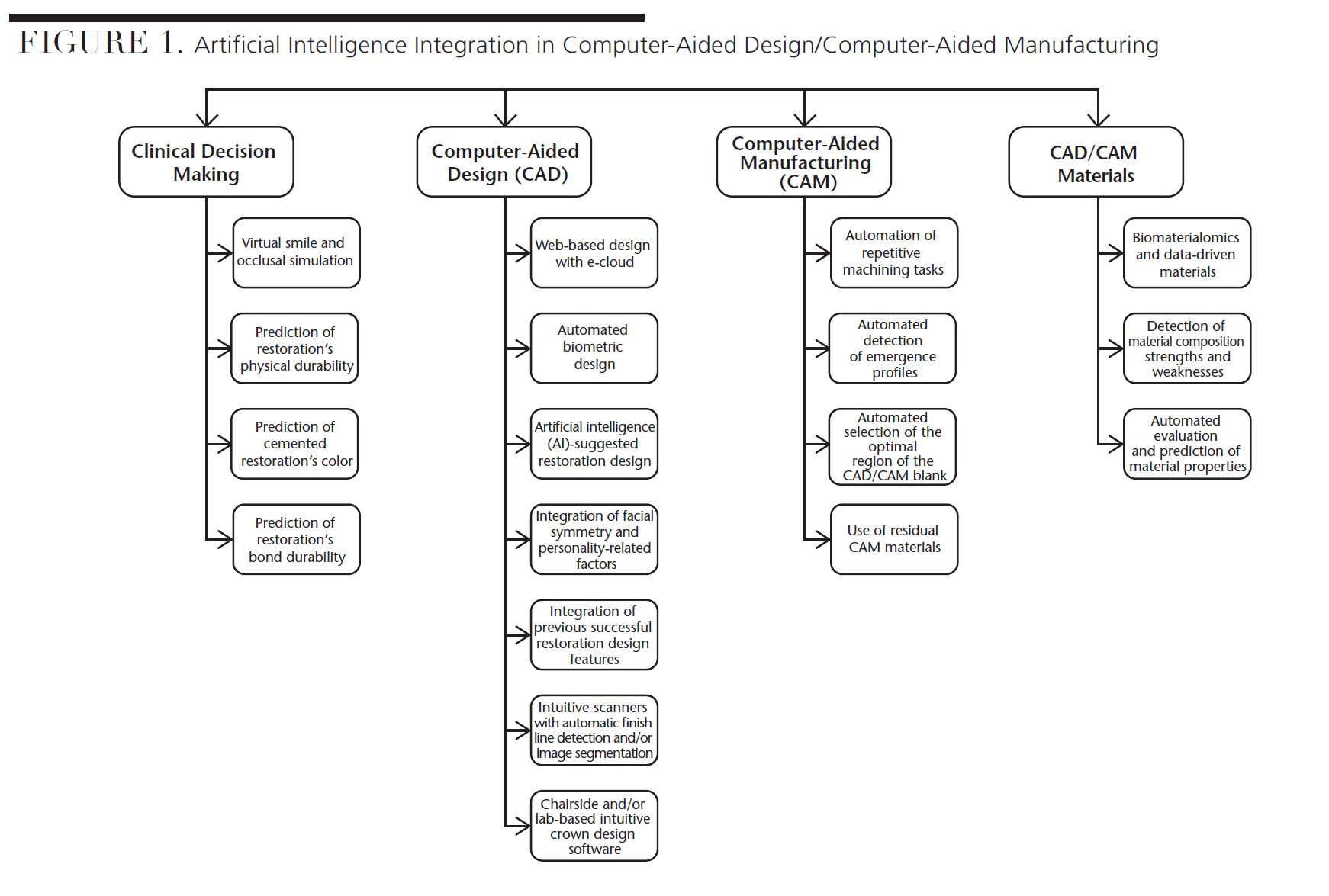
As CAD/CAM systems continue to evolve, artificial intelligence (AI) is increasingly integrated into digital dentistry. AI-driven algorithms are now capable of assisting with margin detection, tooth shade selection, occlusal design, and esthetic customization based on large datasets of prior restorations.14 These tools have the potential to reduce operator variability, improve efficiency, and enhance consistency across restorations.
In restorative dentistry and dental materials research, AI has also shown promise in predicting restoration performance, including debonding risk and the influence of material composition on mechanical properties.15 These advancements may translate into more predictable outcomes and simplified workflows, particularly as same-day dentistry becomes more prevalent (Figure 1).
Advantages
Chairside digital workflows eliminate the need for conventional impressions, provisional restorations, and multiple appointments. This reduction in clinical steps not only improves efficiency but also minimizes opportunities for error, such as impression distortion or provisional crown failure.16
From a patient perspective, same-day dentistry offers convenience; reduced time away from home, work, or travel; and immediate resolution of functional and esthetic concerns. From a practice management standpoint, in-office fabrication can become economically viable with relatively modest restoration volumes, offsetting the initial capital investment over time.17
Successful integration of CAD/CAM technology requires training, team involvement, and thoughtful scheduling. While highly complex esthetic cases may still benefit from laboratory collaboration, most single-unit restorations can be predictably managed in-house with excellent results.18
Conclusion
CAD/CAM technology has transformed restorative dentistry by combining precision, efficiency, and patient-centered care. Digital workflows provide a practical means of delivering high-quality restorations while streamlining clinical processes. As materials, software, and artificial intelligence continue to advance, the role of CAD/CAM in everyday practice is expected to expand further. Embracing this technology allows clinicians to meet today’s patient expectations while maintaining clinical excellence and practice sustainability.
References
- Ahmed KE. We’re going digital: the current state of CAD/CAM dentistry in prosthodontics. Prim Dent J. 2018;7:30-35.
- Vecsei B, Czigola A, Roth I, Hermann P, Borbely J. Digital impression systems, CAD/CAM, and STL file. In: Kinariwala N, Samaranayake L, eds. Guided Endodontics. Cham, Switzerland: Springer; 2021:27-63.
- Thakkar P, Surathu N, Surathu N, Lawson N. Contempory indirect restorations: a review of subtractive and additive materials and techniques. Compendium. 2025;46:10.
- Lambert H, Durand JC, Jacquot B, Fages M. Dental biomaterials for chairside CAD/CAM: state of the art. J Adv Prosthodont. 2017;9:486-495.
- Takaichi A, Fueki K, Murakami N, et al. A systematic review of digital removable partial dentures. Part II: CAD/CAM framework, artificial teeth, and denture base. J Prosthodont Res. 2022;66:53-67.
- Jeong M, Radomski K, Lopez D, Liu JT, Lee JD, Lee SJ. Materials and applications of 3d printing technology in dentistry: an overview. Dent J (Basel). 2023;12:1.
- Raja SR, Mahaprasad A, Satapathy S, et al. In vitro evaluation of surface roughness and bacterial adhesion on different CAD/CAM restorative materials. J Pharm Bioallied Sci. 2025;17(suppl 1):S552-S559.
- Yeslam H, von Maltzahn N, Nassar H. Revolutionizing CAD/CAM-based restorative dental processes and materials with artificial intelligence: a concise narrative review. PeerJ. 2024;12:e17845.
- Najeeb M, Islam S. Artificial intelligence in restorative dentistry: current trends and future prospects. BMC Oral Health. 2025;25:592-599.
- Solís-Pinargote NW, Yanushevich O, Krikheli N, et al. Materials and methods for all-ceramic dental restorations using CAD/CAM technologies: a narrative review. Dent J (Basel). 2024;12(2):47.
- Hajaj T, Marian D, Zaharia C, et al. Influence of marginal preparation design on fracture resistance of CAD/CAM ceramic crowns. J Funct Biomater. 2025;16:205.
- Abu Alhuda S, Arossi GA, Anagnostopoulos-King F, et al. Current evidence and advances in CAD/CAM resin composite blocks for chairside dental restorations. Appl Sci. 2024;14:10423.
- Ling X, Ma Y, Malyala R, et al. Survival rates of CAD/CAM ceramic dental restorations: a systematic review and meta-analysis. Med (Basel). 2026;12(1):Epub ahead of print.
- Mihali SG, Pradelli G, Manfredi M, et al. State-of-the-art zirconia and glass-ceramic materials in restorative dentistry. Appl Sci. 2025;15:12841.
- Darwood A, Sauret-Jackson V, Marti B, Dawood A. Clinical accuracy and precision of intraoral scanning in dentistry: a systematic review. J Prosthodont Res. 2022;66:53-67.
- Refaey HS, Abdelrahman T, El-Damanhoury HM, et al. Effect of preparation design on marginal fit and fracture resistance of zirconia-reinforced lithium disilicate CAD/CAM overlays. BMC Oral Health. 2025;25:Epub ahead of print.
- Rekow ED. Digital dentistry: the new state of the art—is it disruptive or destructive? Dent Mater. 2020;36:9-24.
- Schwendicke F, Samek W, Krois J. Artificial intelligence in dentistry: chances and challenges. J Dent Res. 2020;99:769-774.
From Decisions in Dentistry. September/October 2026;12(2):16-19.