

The Race for Precision in Implant Dentistry
From static surgical guides to dynamic navigation and robotic-assisted systems, advances in implant placement technology offer greater precision, but which approach delivers the best results for each clinical scenario?
Malpositioned implants can produce biomechanical overload, failed osseointegration, peri-implant disease, and compromised prosthetic outcomes.1 Mesiodistal malposition leads to altered emergence profiles and papilla formation while apicocoronal malposition can lead to abutment exposure or onset of peri-implant bone loss and peri-implant soft tissue deficiencies.2 Proximity to the inferior alveolar nerve, adjacent roots, and the maxillary sinus further narrows the margin for error.3 Freehand dental implant placement is the currently most widely practiced technique. Although it can provide excellent tactile feedback and requires no specialized equipment, its accuracy depends heavily on operator experience. Mean angular deviations of approximately 6.5° have been reported for freehand cases, compared with roughly 3° for guided approaches.4
Static Surgical Guides
Static guides are digitally designed templates fabricated from cone-beam computed tomography (CBCT) and intraoral scan data.5 Planning software merges these datasets to determine optimal implant position, angulation, and depth. The template is then three-dimensionally printed, typically by stereolithography using a methyl methacrylate resin.6 The type of guide, full or pilot, and the method of support (tooth-borne, mucosa-borne, or bone-borne) are selected based on clinical considerations.7 During surgery, the guide is seated in the mouth and sequential drills pass through metal sleeves that constrain the osteotomy path, often without flap reflection.8
The principal advantage is improved accuracy relative to freehand placement at a comparatively low per-case cost.4 Digital planning also enhances visualization of critical anatomical landmarks before the patient is in the chair.8 Static guides are particularly well suited to the anterior esthetic zone, where predictable positioning of the implant platform directly influences soft-tissue contours and prosthetic emergence.9 On the other hand, the guide cannot be adjusted once fabricated. If intraoperative conditions differ from the plan, for example, unexpected bone density or a guide that does not seat precisely, the clinician has limited recourse.4 Restricted irrigation around the drill sleeves is another concern, because insufficient cooling increases the risk of thermal osteonecrosis, although newer guide designs with internal irrigation channels have substantially mitigated this problem.10
Dynamic Navigation Systems
Dynamic navigation pairs preoperative CBCT planning with real-time optical or electromagnetic tracking of the handpiece relative to the jaw.11 Tracking tags are fixed to the mandible or maxilla, and a calibrated camera array follows both the jaw reference and the drill in 3D. The clinician views a live display showing the drill tip superimposed on the virtual plan, receiving continuous feedback on depth, angulation, and lateral position.12
This method preserves intraoperative flexibility: the surgeon can modify the trajectory in real time if bone conditions or soft-tissue anatomy warrant a change.9 Because there is no physical template in the surgical field, irrigation is unrestricted.8 Dynamic navigation is particularly advantageous in posterior regions where limited mouth opening can make seating a static guide difficult, and in immediate-placement cases where the extraction socket geometry may not match the preoperative plan.13 However, calibration of the jaw tracker and drill is technically demanding and adds to total procedure time.14 Capital equipment costs are higher than those of a static guide workflow (approximately $40,000 for a complete hardware suite) and may be associated with a higher learning curve.15
Robotic-Assisted Systems
Robotic platforms represent the newest tier of computer-assisted implant surgery. The concept originated in 2002 with a robot that held a drill template guided by preoperative position data, and a decade later a stereo-camera–controlled system was developed to align the handpiece with the surgical plan.1 In 2017, the first robotic implant system received United States Food and Drug Administration clearance and remains the only platform approved for clinical use in the US.16 In China, at least five systems have been approved by the National Medical Products Administration.17
The workflow begins with CBCT acquisition, typically with a contralateral stabilizing splint for calibration. Implant planning is completed in dedicated software, and the robotic arm is registered to the patient’s anatomy. During surgery, the arm constrains drill movement through a combination of haptic boundaries and visual guidance, effectively preventing deviation beyond preset tolerances.18 Some systems integrate force and thermal sensing, making them advantageous in cases with compromised bone quality.19 Because the robot eliminates hand tremor and fatigue, precision is maintained even in lengthy multi-implant and full-arch procedures.17
Despite these advantages, robotic systems are not universally applicable. Complex preoperative setup and calibration make them less efficient for straightforward single-implant cases.20 Challenges in posterior regions due to limited maneuverability and susceptibility to side-slipping on ridges during immediate placement have also been reported.16 The platform cost is substantially higher than either guided or navigated workflows, and ongoing support staff and calibration add to operational expense.17
How Do These Technologies Compare?
Several controlled studies have examined accuracy across all three approaches (Figure 1). Guided systems, both static and dynamic, consistently reduce angular deviations to roughly 3°, compared with 6.5° for freehand technique; coronal and apical linear deviations also decrease by 0.5 to 1 mm.4,21 Dynamic navigation tends to show slightly better apical precision than static guides, though the difference has not reached statistical significance in most head-to-head trials.21,22
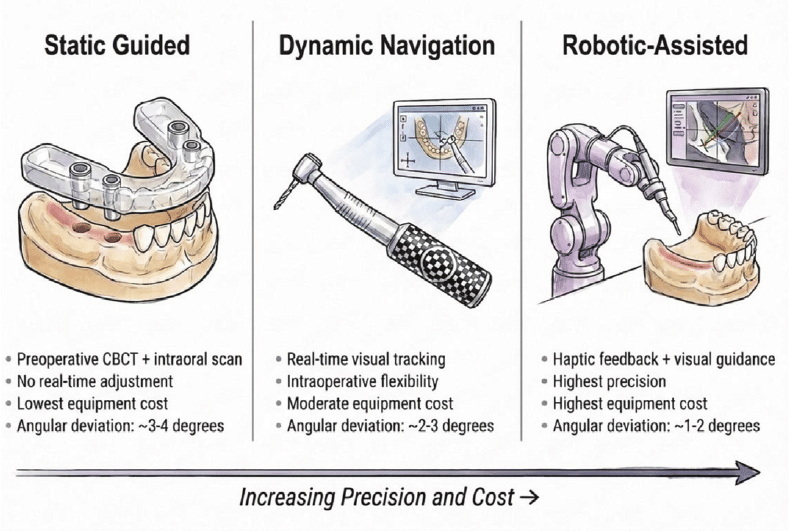
Robotic systems have demonstrated the smallest deviations overall. Yu et al23 reported approximately half the apical and angular deviation of dynamic navigation, with shorter surgical times. An in vitro comparison by Tao et al24 of 480 implants in 80 jaw models found robotic mean angular deviation of 1.00° ± 0.48°, vs 2.41° ± 1.42° for dynamic navigation. Across both in vivo and benchtop data, robotic platforms achieve submillimeter linear deviations and angular precision below 2°.25,26
Choosing the Right Technology
No single technology is optimal for every clinical scenario, and the decision depends on case complexity, anatomical constraints, and available resources (Figure 2). For routine single-implant cases with straightforward anatomy and adequate bone volume, a static surgical guide or even freehand placement may be sufficient, offering predictable results at the lowest cost.4 When the implant site falls within the anterior esthetic zone, a static guide is particularly valuable because the template enforces the precise platform position needed for optimal emergence and papilla formation.9 Outcomes with both freehand and static guided placement remain closely tied to operator training and experience; reducing that dependence is a principal rationale for navigated and robotic workflows.
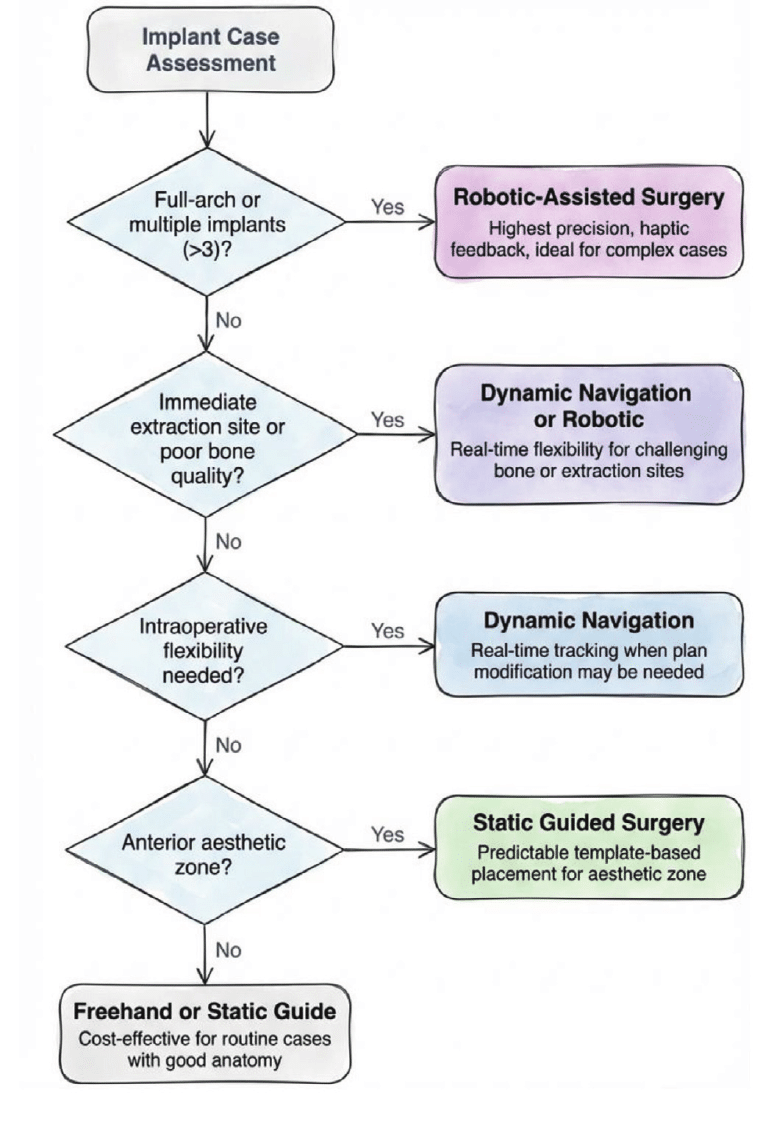
Cases that demand intraoperative flexibility, such as those involving compromised posterior access, immediate placement into extraction sockets, or uncertain bone quality, are better served by dynamic navigation. The ability to adjust the trajectory in real time offsets the unpredictability inherent in these situations.13 When multiple implants must be placed in a single session, particularly in full-arch reconstructions, robotic-assisted surgery offers the greatest advantage: the haptic constraints prevent cumulative drift, and the robot does not fatigue over a lengthy procedure.18 For immediate-placement cases, both dynamic navigation and robotic systems are well suited, because they can adapt to the geometry of a fresh extraction socket that may not conform to the preoperative plan.16
Cost is a practical consideration that cannot be ignored. Static guides involve the lowest per-case expenditure and minimal capital investment. Dynamic navigation requires a dedicated hardware suite costing approximately $40,000. Robotic systems carry the highest price point, roughly more than $100,000, and demand dedicated support staff and ongoing calibration.17 Practices considering adoption should weigh case volume, case mix, and long-term return on investment alongside clinical performance data.
Barriers to Adoption
High capital cost is the most frequently cited obstacle. A robotic implant system represents roughly five times the investment of a dynamic navigation suite, which itself exceeds the per-case cost of static guides by an order of magnitude.17 In the US, the FDA regulatory pathway adds a further hurdle: dental robotic devices must demonstrate substantial equivalence to a predicate through the 510(k) process or pursue the more rigorous De Novo classification.27 Training requirements are also significant, as each technology carries its own learning curve for both dentists and assistants, and dedicated hands-on instruction is necessary before integrating any system into clinical practice.15
Case Study
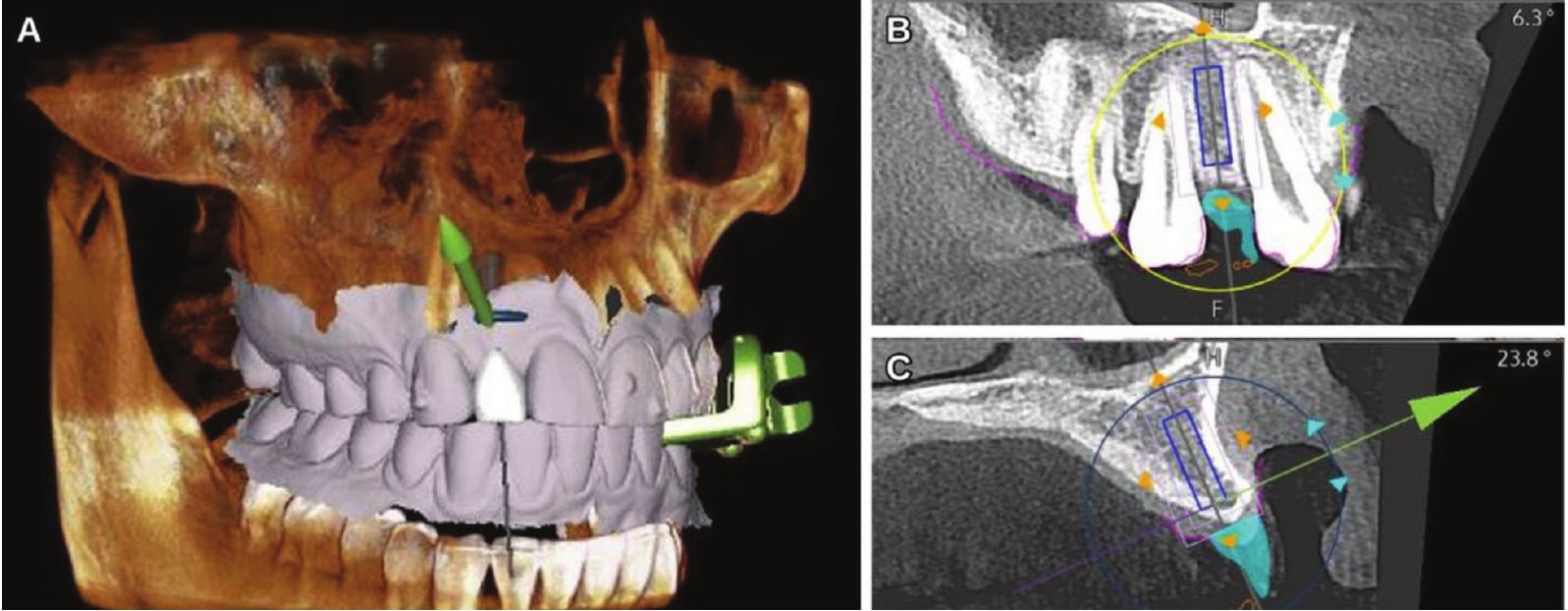
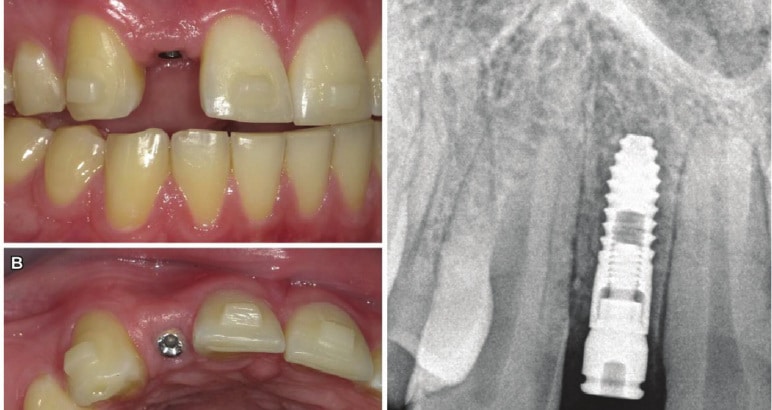
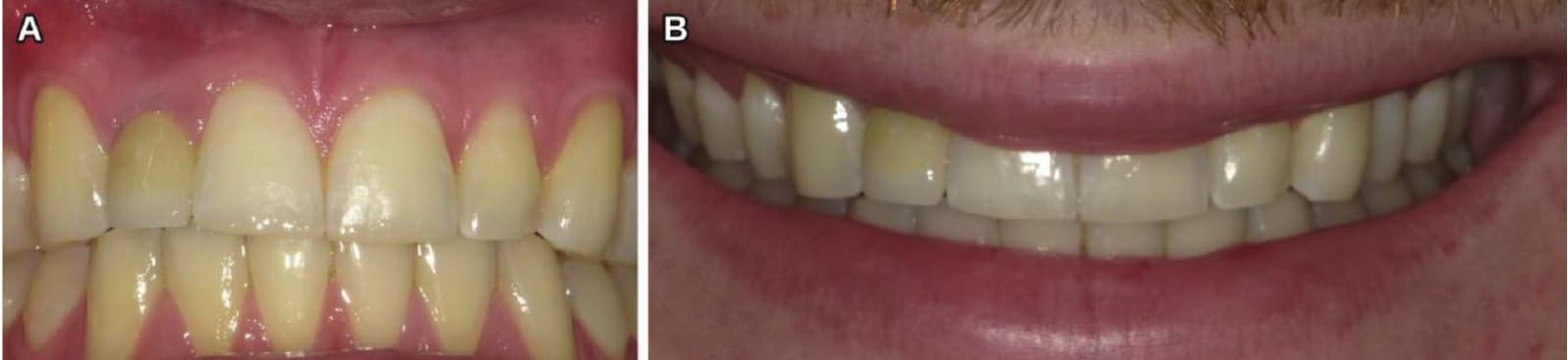
Figures 3 to 5 show a dynamically navigated case. A 20-year-old man received virtual implant planning for replacement of a congenitally missing maxillary right lateral incisor using a dynamic navigation system. A 3D reconstruction of the CBCT volume merged with the digital intraoral scan, showing the virtual restoration at the #7 site, the planned implant trajectory, and the fiducial clip seated on the left posterior teeth. The panoramic CBCT section shows the planned implant between the roots of the adjacent canine and central incisor, with the virtual restoration. Buccopalatal CBCT section shows the planned implant position and prosthetically driven trajectory within the residual alveolar ridge (Figure 3). The implant was placed at the #7 site under full dynamic navigation after a flap elevation. No bone or soft-tissue grafting was needed (Figure 4). The final implant-supported restoration was successfully placed at #7 (Figure 5).
Conclusion
Static guides, dynamic navigation, and robotic-assisted systems each occupy a distinct niche along the spectrum of computer-assisted implant surgery. Static guides offer the most accessible entry point for straightforward cases. Dynamic navigation provides real-time flexibility for moderately complex situations. Robotic platforms deliver the highest precision for demanding multi-implant and full-arch reconstructions but at substantially greater cost. For now, selecting the right tool for each case, rather than defaulting to the most advanced option, remains the most prudent clinical strategy.
The authors have no commercial conflicts of interest to disclose.
References
- Huynh KP, Mangui G. From tradition to technology: robotic artificial intelligence in dental implantology. Cureus. 2024;16:e73340.
- Chen ST, Buser D, Sculean A, Belser UC. Complications and treatment errors in implant positioning in the aesthetic zone: diagnosis and possible solutions. Periodontol 2000. 2023;92:220-234.
- Mistry A, Ucer C, Thompson JD, Khan RS, Karahmet E, Sher F. 3D guided dental implant placement: impact on surgical accuracy and collateral damage to the inferior alveolar nerve. Dent J (Basel). 2021;9:99.
- Liu C, Liu Y, Xie R, Li Z, Bai S, Zhao Y. The evolution of robotics: research and application progress of dental implant robotic systems. Int J Oral Sci. 2024;16:28.
- Nirula P. Feedback on dental implants with dynamic navigation versus freehand. Bioinformation. 2023;19:290-294.
- D’haese J, Ackhurst J, Wismeijer D, De Bruyn H, Tahmaseb A. Current state of the art of computer-guided implant surgery. Periodontol 2000. 2017;73:121-133.
- Senthil S. Current opinion on guided implant surgery. Bioinformation. 2023;19:786.
- Khaohoen A, Powcharoen W, Sornsuwan T, et al. Accuracy of implant placement with computer-aided static, dynamic, and robot-assisted surgery: a systematic review and meta-analysis of clinical trials. BMC Oral Health. 2024;24:359.
- Block MS, Emery RW, Cullum DR, Sheikh A. Implant placement is more accurate using dynamic navigation. J Oral Maxillofac Surg. 2017;75:1377-1386.
- Teich S, Bocklet M, Evans Z, Gutmacher Z, Renne W. 3D printed implant surgical guides with internally routed irrigation for temperature reduction during osteotomy preparation: a pilot study. J Esthet Restor Dent. 2022;34:796-803.
- Cecchetti F, Di Girolamo M, Ippolito DG, Baggi L. Computer-guided implant surgery: analysis of dynamic navigation systems and digital accuracy. J Biol Regul Homeost Agents. 2020;34(3 Suppl 1):9-17.
- Kuo PJ, Lin CY, Hung TF, Chiu HC, Kuo HY. A novel application of dynamic guided navigation system in immediate implant placement. J Dent Sci. 2022;17:354-360.
- Raju MS, Gottumukkala SNVS, Rakshitha KSS, Raju Ma KV. Precision implant placement: a novel approach using dynamic navigation system-guided alveolar ridge splitting. J Indian Prosthodont Soc. 2025;25:179-184.
- Parra-Tresserra A, Marquès-Guasch J, Ortega-Martínez J, Basilio-Monné J, Hernández-Alfaro F. Current state of dynamic surgery: a literature review. Med Oral Patol Oral Cir Bucal. 2021;26:e576-e581.
- Ahmad P, Alam MK, Aldajani A, et al. Dental robotics: a disruptive technology. Sensors. 2021;21:3308.
- Shi J, Liu B, Wu X, et al. Improved positional accuracy of dental implant placement using a haptic and machine-vision-controlled collaborative surgery robot: a pilot randomized controlled trial. J Clin Periodontol. 2024;51:24-32.
- Lee A, Baker TS, Bederson JB, Rapoport BI. Levels of autonomy in FDA-cleared surgical robots: a systematic review. NPJ Digit Med. 2024;7:103.
- Bolding SL, Reebye UN. Accuracy of haptic robotic guidance of dental implant surgery for completely edentulous arches. J Prosthet Dent. 2022;128:639-647.
- Chen D, Chen J, Wu X, Chen Z, Liu Q. Prediction of primary stability via the force feedback of an autonomous dental implant robot. J Prosthet Dent. 2024;132:1299-1308.
- Younis H, Xu B, Acharya K, et al. Accuracy of robot-assisted implant surgery versus freehand placement: a retrospective clinical study. Int J Implant Dent. 2025;11:1.
- Li K, Li T, Guo G, et al. Dynamic navigation vs. static navigation in implant placement: a meta-analysis. J Dent. 2024;151:105395.
- Wu D, Zhou L, Yang J, et al. Accuracy of dynamic navigation compared to static surgical guide for dental implant placement. Int J Implant Dent. 2020;6:78.
- Yu M, Luo Y, Li B, Xu L, Yang X, Man Y. A comparative prospective study on the accuracy and efficiency of autonomous robotic system versus dynamic navigation system in dental implant placement. J Clin Periodontol. 2025;52:280-288.
- Tao B, Feng Y, Fan X, et al. Accuracy of dental implant surgery using dynamic navigation and robotic systems: an in vitro study. J Dent. 2022;123:104170.
- Xu Z, Zhou L, Han B, et al. Accuracy of dental implant placement using different dynamic navigation and robotic systems: an in vitro study. NPJ Digit Med. 2024;7:182.
- Chen J, Bai X, Ding Y, et al. Comparison the accuracy of a novel implant robot surgery and dynamic navigation system in dental implant surgery: an in vitro pilot study. BMC Oral Health. 2023;23:179.
- Alqutaibi AY, Hamadallah HH, Abu Zaid B, Aloufi AM, Tarawah RA. Applications of robots in implant dentistry: a scoping review. J Prosthet Dent. 2025;134:1052-1061.
From Decisions in Dentistry. November/December 2026;12(3):18–21.