

Beautiful Anterior Composites in Minutes
Bisco’s Quantum Universal Composite System combines strength, polishability, and simplified layering to produce lifelike esthetics with remarkable efficiency.
Bisco’s Quantium Universal Composite System is a truly unique product. Ten years of research and development have yielded a versatile system that can be used with confidence in the posterior and anterior regions. New filler technology using prepolymerized filler combines the best qualities of nanofills and microfills to create a low shrinkage, highly polishable, and radiopaque restoration.
Quantium is available in six body shades and six enamel shades, including A1, A2, A3, A3.5, B1, and B2, as well as a bleach and translucent incisal shade. The incisal shade is ideal for building a palatal shell layer that allows light to be transmitted through to recreate nature along the incisal edge. With impressive compressive and flexural strengths, Quantium (unit-dose only) is designed to be used at room temperature or warmed. Clinicians will appreciate the easy handling and durability, whether heated or not.
When restoring anterior teeth, the clinician must decide whether to use a single shade or layered approach. The size of the restoration and appearance of adjacent teeth play a big role in determining how many layers are necessary to create a seamless restoration. Quantium is forgiving and flexible and allows room for error with its simplified shade palette. This flexibility allows for quick clinical decisions regarding shade and yields a blended restoration at the transition zone between the tooth and resin, even when the clinician is short of time.
Clinical Case Report
In the following case, the patient presented for a scan for final retainers after completing orthodontic treatment with clear aligners. The patient was happy with the alignment of her teeth but was concerned about the appearance of her worn maxillary lateral incisors. She opted to have #7 (Figure 1) and 10 (Figure 2) restored with composite resin rather than porcelain prior to fabricating her retainers. The restoration of #7 and 10 was not planned ahead of time, so quick decisions had to be made to stay on schedule. Quantium A2 body and A2 enamel shades were chosen to restore the worn and fractured incisal edges. A scalloped bevel was placed at the transition zone. The preps were microabraded prior to being selectively etched to increase the bond strength. The adhesive Allbond Universal by Bisco was used. Quantium A2 Body was placed via a freehand technique without stents, and up to midway into the scalloped bevel. Once cured, a layer of Quantium A2 enamel was placed over the first layer and extended apically beyond the bevel.
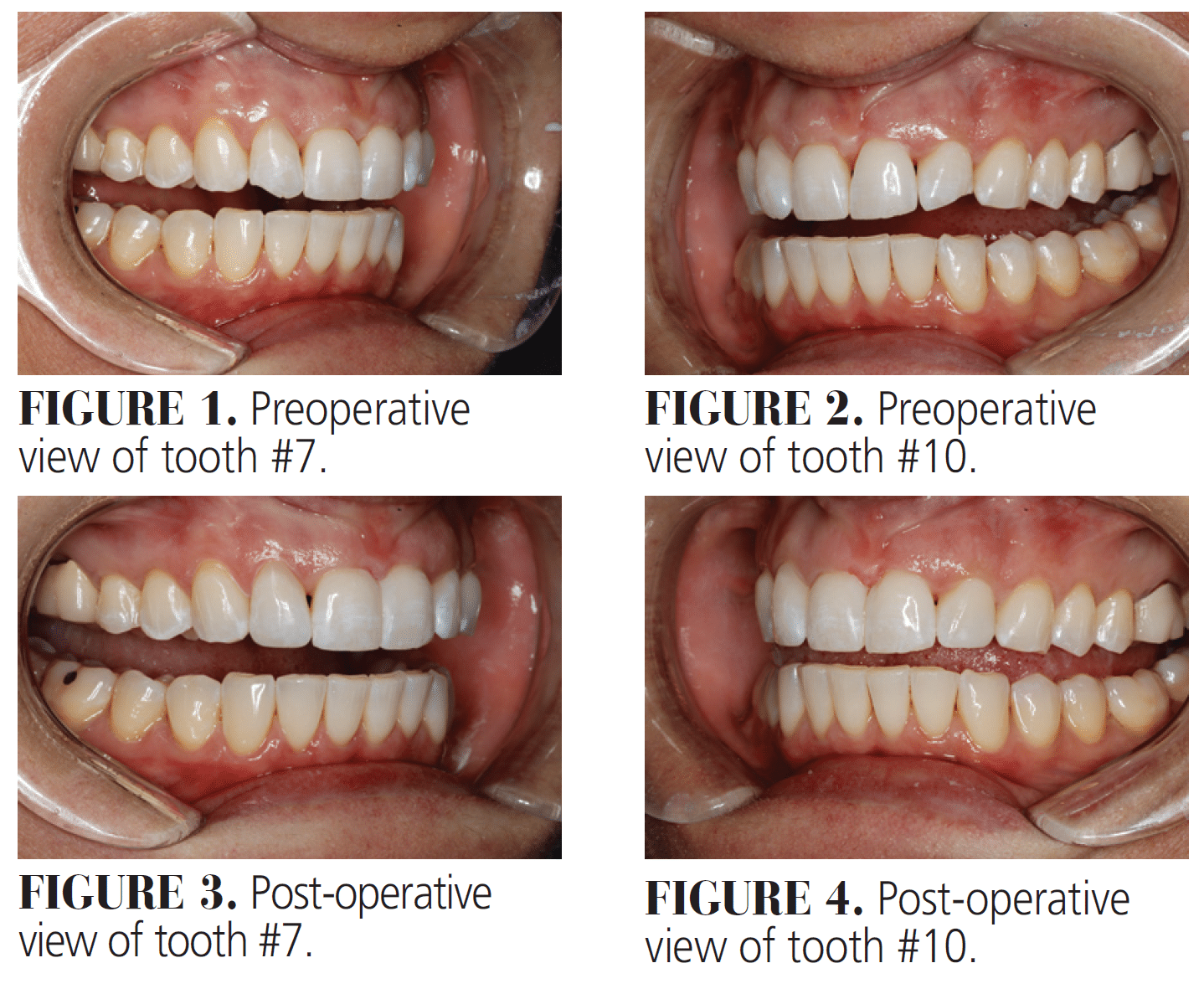
After curing, a series of finishing and polishing steps was completed. A polishing paste was not used as a final step in this case. Though the occlusion was addressed in the clear aligner treatment plan, a resin material with high strength was the most appropriate choice. If the adjacent teeth had displayed a moderate to high level of incisal translucency, a palatal layer using Quantium incisal could have been used in addition to the body and enamel shades.
Photos were taken immediately post-op and the transition line between enamel and resin was difficult to detect (Figures 3 and 4). The patient was very happy with the results. She did not need to be anesthetized and realized an instant cosmetic improvement with no restrictions to follow after the appointment. Both restorations were completed in less than 15 minutes.
Quantium Universal offers excellent value and is an essential material for predictable anterior resin restorations. It can be used as a standalone, single shade option, or a multilayered restoration to create beautiful results that are likely to last.
BISCO
bisco.com
800-247-3368
From Decisions in Dentistry. September/October 2026;12(2):23.