

Closing the Gap on Black Triangles
Tokuyama’s OMNICHROMA simplifies shade matching and streamlines direct composite bonding.
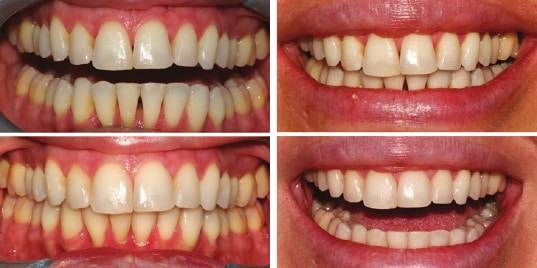
Severe anterior black triangles can be particularly challenging for patients because they can dramatically affect smile esthetics. This patient presented with significant anterior black triangles and desired an esthetic improvement without invasive restorative treatment.
Direct composite bonding has become my preferred treatment for patients seeking conservative closure of anterior black triangles. It preserves healthy tooth structure, can often be completed in a single visit, and allows for excellent esthetic outcomes when proper emergence profiles and contours are created. While the procedure itself is technique-sensitive, establishing a consistent workflow and using materials that simplify the restorative process can make treatment more predictable and efficient.
Before every case, I capture high-quality retracted and nonretracted preoperative photographs, ensuring the teeth are clean and dry so the full extent of the black triangles can be accurately documented.
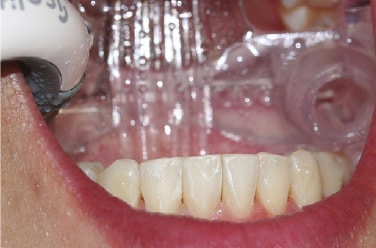
Isolation is one of the most important factors for success. When restoring the mandibular anterior teeth, one of my favorite clinical tips is using the new anterior Isolite (Figure 1). Having unobstructed access allows for more precise composite placement and reduces operator fatigue during detailed anterior restorations.
After isolation, selecting the appropriate matrix is one of the most important steps. I spend time choosing the correct matrix height and width before beginning the restoration. If there is a slight discrepancy in the fit, I prioritize adaptation on the lingual surface rather than the facial. The facial aspect is much easier to adjust during finishing, whereas an improperly adapted lingual contour can be far more difficult to correct once the restoration is complete.
Before beginning the restoration, I place both OMNICHROMA Flow and a compule of OMNICHROMA into a composite heater. Although OMNICHROMA already has excellent handling characteristics, warming both materials improves their flow and adaptation to the tooth surface. This allows the composite to better adapt into the gingival embrasure and minimizes the potential for internal voids.
Once the matrices are seated, I first inject heated OMNICHROMA Flow from the lingual toward the facial aspect of the black triangle, allowing the material to adapt intimately to the tooth surface. A heated compule of OMNICHROMA is then placed over the flowable, and I use an OptraSculpt paddle or a plastic composite instrument to gently contour the material until it is flush with the matrix. If a small amount of flowable is expressed beyond the margins, I remove it with a microbrush.
Following the initial cure, I apply glycerin gel along the restoration margins and perform an additional light cure. Eliminating the oxygen-inhibited layer helps ensure complete polymerization of the surface layer and, in my experience, contributes to maintaining surface polish and minimizing marginal discoloration over time.
Cosmetic bonding can be intimidating because success depends on two critical factors: color and contour. OMNICHROMA eliminates much of the uncertainty surrounding shade selection, allowing me to focus on creating natural line angles and emergence profiles that reflect light like adjacent enamel. This simplified approach reduces stress during treatment while delivering highly esthetic results.
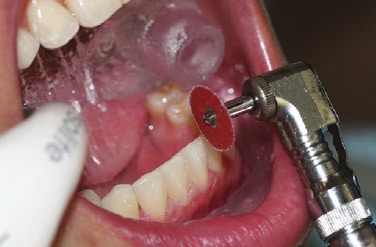
After finishing the restorations, I use Flexidiscs to refine line angles and create a natural surface anatomy that blends seamlessly with the surrounding dentition (Figure 2). The patient was thrilled with the outcome and reported feeling significantly more confident for her wedding day. She later shared that the restoration had transformed her smile and allowed her to smile freely during one of the most important moments of her life. Moments like these remind me why I enjoy treating black triangles — achieving a dramatic esthetic improvement through a conservative, additive procedure that preserves healthy tooth structure and gingival tissues.
Tokuyama Dental America
tokuyama-us.com
877-378-3548
From Decisions in Dentistry. November/December 2026;12(3):26.