


The Impact of Naked-Eye Dentistry
Magnification aids are key to optimizing posture in the dental setting.
PURCHASE COURSE
This course was published in the November/December 2026 issue and expires December 31, 2029. The author has no commercial conflicts of interest to disclose. This 2 credit hour self-study activity is electronically mediated.
AGD Subject Code: 770
Educational Objectives
After reading this course, the participant should be able to:
- Identify the importance of neutral posture in ergonomic dentistry.
- Discuss the different types of magnification systems.
- Explain the role of four-handed dentistry in ergonomic dentistry.
Dentistry is one of the most physically demanding professions in healthcare. Musculoskeletal disorders (MSDs), chronic neck and back pain, and occupational burnout affect a substantial percentage of oral health professionals throughout their careers.1,2 These issues often begin during dental school and may progress over decades of repetitive motion, prolonged static positioning, visual strain, and poor ergonomic habits.3,4 As the profession increasingly emphasizes longevity, efficiency, and clinician wellness, ergonomics and human factor engineering have become central to modern dental practice.
Ergonomics refers to the optimization of physical work environments and movements to improve efficiency while reducing injury risk. Human factors, or macroergonomics, expands this concept to include organizational, cognitive, and behavioral considerations that influence performance.5 In dentistry, these principles intersect continuously. Physical fatigue affects cognitive function, decision-making, concentration, and procedural accuracy, while mental stress often manifests through muscle tension and altered posture.6
More than 90% of oral health professionals report work-related musculoskeletal symptoms during their careers, with neck and shoulder disorders among the most prevalent complaints.1 Forward head posture (FHP), repetitive cervical flexion, static seated positioning, and prolonged visual concentration contribute significantly to these findings. Professions requiring sustained cervical flexion beyond 20° for prolonged periods demonstrate substantially increased rates of cervical strain and disability.7 In dentistry, clinicians frequently maintain forward head posture exceeding 30° for most of the working day.
The biomechanical consequences of these working patterns are significant. The average human head weighs approximately 10 to 14 pounds in neutral posture, but the effective load on the cervical spine increases dramatically as the head moves anteriorly (Figure 1).8 For every inch of forward displacement, the cervical musculature and supporting structures experience substantially greater compressive and tensile forces. Over time, these repetitive stresses may contribute to muscular fatigue, cervical disc degeneration, joint dysfunction, headaches, and chronic pain syndromes.
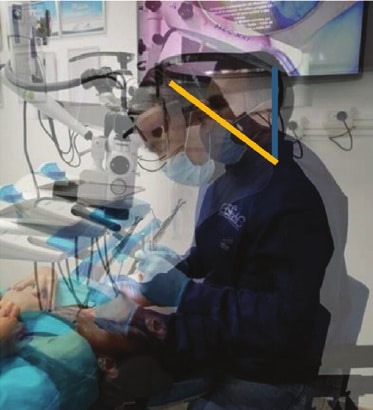
The C6 and C7 vertebral segments are particularly vulnerable because they function as biomechanical fulcrums during prolonged cervical flexion and rotational movements.9 Dentistry further compounds these stresses because procedures often require sustained precision within confined visual fields under limited lighting conditions. As clinicians attempt to improve visualization using naked-eye dentistry alone, they frequently compensate by moving closer to the operative field and increasing cervical flexion (Figure 2).
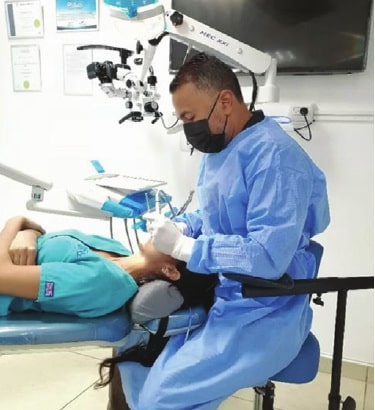
Visual limitations are therefore directly linked to operator posture. The ideal near point of distinct vision for the human eye is approximately 25 cm.10 However, the typical working distance between the operator’s eyes and the patient’s oral cavity ranges from 35 to 45 cm. This discrepancy forces clinicians using unaided vision to lean forward and downward to visualize fine anatomical details. The confined nature of the oral cavity, shadowing, moisture, and small restorative margins further magnify this challenge.
As a result, modern magnification technologies should no longer be viewed solely as tools for visual enhancement. Rather, they represent essential ergonomic instruments capable of improving posture, precision, and long-term occupational health.
Neutral Posture and Cranio-Cervical Alignment
Neutral posture is foundational to ergonomic dentistry. Ideally, the head should remain aligned over the shoulders with minimal cervical flexion, while the shoulders, elbows, wrists, and lumbar spine maintain balanced positioning throughout clinical procedures.11 Proper cranio-cervical alignment minimizes muscular strain and distributes biomechanical forces more efficiently across the cervical spine.
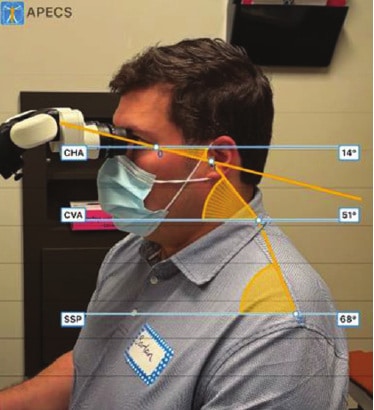
One commonly used assessment metric is the craniovertebral angle (CVA), measured between the tragus of the ear and the C7 spinous process in the sagittal plane.12 A reduced CVA correlates with forward head posture and cervical dysfunction. Angles less than approximately 48° to 50° are generally associated with pathologic forward head posture and increased cervical strain (Figure 3).13
FHP is frequently accompanied by rounded shoulders, thoracic kyphosis, and muscular imbalance involving the cervical extensors, trapezius, levator scapulae, and pectoral musculature.14 Common clinical symptoms include neck stiffness, headaches, trapezius pain, shoulder fatigue, and reduced range of motion. Over time, chronic postural dysfunction may impair both comfort and procedural efficiency.
The importance of ergonomic education early in dental training cannot be overstated. Studies have demonstrated that musculoskeletal symptoms begin during preclinical and clinical education, often before professional practice is established.3 Many students develop compensatory working habits early that persist throughout their careers. Incorporating magnification, ergonomic positioning, assistant utilization, and posture training into dental curricula may therefore significantly influence long-term occupational health.
Magnification and Ergonomic Dentistry
Magnification systems have transformed modern dentistry by improving visual acuity while facilitating more neutral working postures. Loupes and surgical microscopes reduce the need for excessive cervical flexion by allowing clinicians to maintain an appropriate working distance while enhancing visualization of fine anatomical details.
Conventional loupes remain widely used across general and specialty practice. These systems may be categorized by mounting style, including through-the-lens (TTL) and flip-up designs, as well as by optical configuration, such as Galilean and Keplerian systems.15 When properly selected according to the operator’s anthropometric measurements and working distance, loupes improve visual performance and may reduce musculoskeletal strain.
However, traditional loupe systems still present ergonomic limitations because many require the clinician to tilt the head downward to align the visual axis with the operative field. Although significantly superior to naked-eye dentistry alone, improperly fitted conventional loupes may still perpetuate cervical strain if declination angle, interpupillary distance, or working distance are not customized appropriately.
This has led to the development of ergonomic loupes incorporating advanced prism technology capable of redirecting the visual axis while allowing the operator to maintain a more neutral head posture. Modern ergonomic loupes may redirect the visual axis by approximately 60° to 65° internally, substantially reducing cervical flexion during treatment.16 Unlike conventional loupe systems that often encourage downward head tilt, ergonomic prism designs allow clinicians to maintain a straighter cervical spine while visualizing the operative field.
Several recent studies evaluating ergonomic loupes have demonstrated measurable improvements in neck angulation, shoulder positioning, and operator comfort when compared to conventional loupe systems or naked-eye dentistry.15,16 These findings are particularly relevant given the increasing prevalence of neck pain and musculoskeletal fatigue among younger clinicians and dental students.
The importance of customization cannot be overstated. Proper working distance should be measured with the operator seated in neutral posture and the patient positioned correctly relative to the clinician’s elbows and visual axis. Inaccurate measurements may negate the ergonomic benefits of magnification entirely. Clinicians frequently purchase magnification systems based primarily on magnification power without adequate attention to posture, declination angle, frame weight, or working distance.
Weight distribution also significantly affects comfort and usability. Excessively heavy loupe systems may increase strain on the cervical musculature despite improved visualization. Contemporary ultra-lightweight designs and improved frame materials attempt to reduce this burden while maintaining optical quality. Adjustable nose bridges, balanced weight distribution, and proper frame fit all contribute to clinician tolerance during prolonged procedures.
Another important consideration is adaptation. Transitioning to magnification-assisted dentistry often requires a period of neuromuscular retraining. Clinicians accustomed to naked-eye dentistry may initially experience discomfort while learning to maintain appropriate posture and visual positioning through magnification systems. However, once adaptation occurs, many practitioners report improved comfort, reduced fatigue, and enhanced procedural confidence.
The Surgical Microscope
The contemporary surgical microscope represents the most advanced magnification modality currently available in dentistry. Long utilized in microsurgical specialties, such as neurosurgery, ophthalmology, and otolaryngology, the dental operating microscope provides coaxial illumination, variable magnification, improved depth of field, enhanced visualization, and superior ergonomics.17
The microscope differs fundamentally from loupe-based systems because it externalizes the visual axis and establishes a fixed ergonomic working posture. Rather than bringing the clinician closer to the patient, the microscope brings the image closer to the clinician. This distinction has profound ergonomic implications.
Since its introduction into modern dentistry by Carr in the early 1990s, microscope-assisted dentistry has been most strongly associated with endodontics.18 In 1997, microscope training became mandatory within accredited endodontic specialty programs in the United States. However, the applications of high magnification extend well beyond endodontics alone (Figure 4).
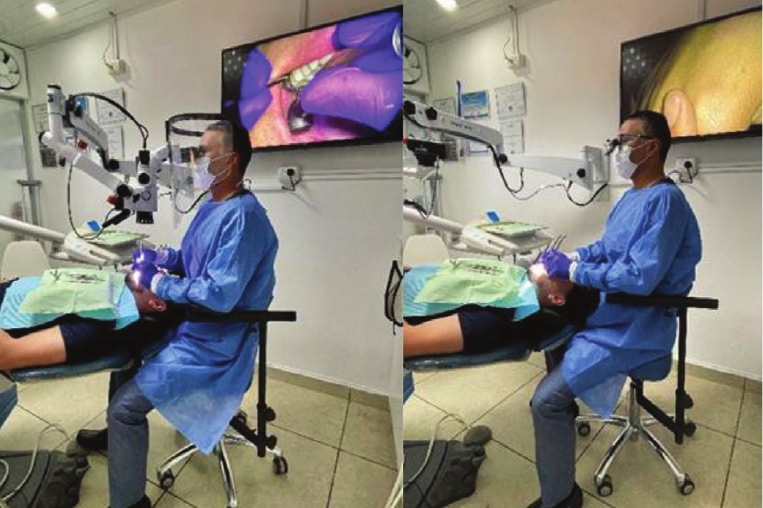
Virtually every dental discipline benefits from enhanced visualization. In restorative dentistry, magnification improves identification of marginal discrepancies, cracks, open contacts, and restorative defects. In periodontics and implant surgery, microsurgical principles permit smaller incisions, more precise flap management, improved visualization of tissue planes, and refined suturing techniques.19 In prosthodontics, magnification enhances preparation design, margin evaluation, and prosthetic fit. Surgical visualization also improves clinician precision while potentially reducing unnecessary tissue trauma.
High magnification may also influence treatment philosophy itself. Improved visualization often promotes more conservative and biologically respectful dentistry by allowing clinicians to identify pathology earlier, preserve healthy tooth structure, and execute procedures with greater precision. Enhanced visualization can additionally improve communication with patients through photographic and video documentation capabilities integrated within many microscope systems.
From an ergonomic perspective, the microscope fundamentally alters operator posture. Unlike naked-eye dentistry, microscope optics establish a defined working distance, typically ranging between 250 and 450 mm depending on the optical configuration.20 This allows the clinician to maintain a neutral cervical posture with only minimal downward gaze through the binoculars.
When ergonomic microscope positioning is properly established, the clinician can maintain a relatively upright seated posture with stable shoulder positioning and reduced cervical strain. Armrests and ergonomic seating further support upper extremity stabilization.
Continuous microscope use throughout procedures is important. Intermittent transitions between magnified and naked-eye visualization may encourage repeated posture changes and awkward cervical movements.21 Continuous use supports more stable positioning and promotes ergonomic consistency throughout treatment.
Despite these advantages, barriers to widespread microscope adoption remain. Cost, training requirements, operatory integration, and perceived learning curves continue to limit implementation. In reality, the primary challenge is behavioral rather than technological. Microscope-assisted dentistry requires clinicians to fundamentally rethink positioning, movement, assistant integration, and workflow.
Modern microscope systems have nevertheless become increasingly user-friendly. Contemporary designs incorporate improved optics, continuous zoom capabilities, enhanced illumination systems, binocular extenders, and greater maneuverability. These advances reduce operator frustration and facilitate integration into everyday clinical workflows.
Importantly, ergonomics should not be viewed as a luxury reserved for specialists or advanced technology users. Rather, ergonomic principles represent foundational aspects of safe and sustainable clinical practice. Even modest improvements in posture, visualization, and movement efficiency may significantly reduce cumulative occupational strain over decades of practice.
Four-Handed Dentistry and Human Factors
Ergonomic dentistry extends beyond posture alone. Efficient workflows, operatory design, instrument positioning, and assistant utilization all influence clinician strain and procedural efficiency.
Four-handed dentistry remains one of the most effective ergonomic strategies in clinical practice.22 Properly trained assistants reduce unnecessary reaching, twisting, and repetitive motion while improving procedural flow. In microscope-assisted dentistry, assistant integration becomes even more important because the operator remains visually fixed within the binocular field while the assistant manages instruments, suction, materials, and peripheral tasks.
Carr’s ergonomic laws of motion emphasize minimizing unnecessary body movements during clinical procedures.23 Ideally, instrument transfer should rely primarily on finger and wrist motion rather than larger shoulder or trunk movements. Concentrating movement within smaller joint systems reduces energy expenditure and cumulative musculoskeletal strain.
Operatory organization also plays an important role. Frequently used instruments and equipment should remain within easy reach, minimizing repetitive twisting and shoulder abduction. Adjustable seating systems, arm supports, optimized lighting, and proper patient positioning further support ergonomic stability.
Importantly, ergonomics and efficiency are not opposing goals. Well-designed ergonomic systems often improve productivity, procedural precision, and clinician endurance simultaneously. As dentistry becomes increasingly technologically driven and procedure-intensive, sustainable clinical workflows become essential not only for practitioner health but also for treatment quality and career longevity.
The Future of Ergonomic Dentistry
Historically, dentistry normalized physical discomfort as an unavoidable consequence of clinical practice. However, contemporary evidence increasingly supports the opposite conclusion. Many occupational injuries are preventable through early ergonomic intervention, magnification integration, proper positioning, assistant training, and workflow optimization.
Modern dental practice should therefore prioritize ergonomics with the same level of importance traditionally given to infection control, radiographic safety, and procedural accuracy. Magnification technologies are no longer optional enhancements reserved for select specialists. Rather, they represent foundational tools that support visualization, precision, posture, and clinician longevity.
As dental education evolves, greater emphasis should be placed on ergonomic principles in the earliest stages of preclinical training. Students should be taught not only how to perform procedures, but how to perform them sustainably over decades of practice.
Conclusion
MSDs remain highly prevalent throughout dentistry and continue to affect clinician health, productivity, and career longevity. The visual limitations inherent to naked-eye dentistry contribute substantially to forward head posture, cervical strain, and repetitive occupational injury. Contemporary magnification systems, including ergonomic loupes and surgical microscopes, allow clinicians to improve visualization while maintaining more favorable working posture and cranio-cervical alignment. When combined with proper assistant utilization, operatory organization, and ergonomic training, these technologies support a more sustainable and efficient model of dental practice. Ultimately, the future of dentistry should prioritize not only procedural excellence, but also the long-term health and functionality of the clinicians delivering that care.
References
- Almeida MB, Póvoa R, Tavares D, Alves PM, Oliveira R. Prevalence of musculoskeletal disorders among dental students: A systematic review and meta-analysis. Heliyon. 2023;9:e19956.
- Negucioiu M, Buduru S, Ghiz S, et al. Prevalence and management of burnout among dental professionals before, during, and after the COVID-19 pandemic: a systematic review. Healthcare. 2024;12:2366.
- Rising DW, Bennett BC, Hursh K, Plesh O. Reports of body pain in a dental student population. J Am Dent Assoc. 2005;136:81-86.
- Nicholas NL, Roshanali P, Kathryn F. Work-related musculoskeletal disorders in dental students: A cross-sectional pilot study from a UK university teaching hospital. J Musculoskelet Disord Treat. 2020;6:2572-3243.
- Carayon P, Karsh BT, Gurses AP, et al. Macroergonomics in health care quality and patient safety. Rev Hum Factors Ergon. 2013;8:4-54.
- Gupta A, Ankola A, Hebbal M. Optimizing human factors in dentistry. Dent Res J. 2013;10:254-259.
- Kawtharani AA, Chemeisani A, Salman F, Haj Younes A, Msheik A. Neck and musculoskeletal pain among dentists: A review of the literature. Cureus. 2023;15:e33609.
- Knudson DV. Fundamentals of Biomechanics. 2nd ed. Columbus, Ohio: Springer; 2007.
- Lindenmann S, Tsagkaris C, Farshad M, Widmer J. Kinematics of the cervical spine under healthy and degenerative conditions: A systematic review. Ann Biomed Eng. 2022;50:1705-1733.
- Sharma IP. RAF near point rule for near point of convergence: A short review. Ann Eye Sci. 2018;2:16.
- Simancek JA, ed. Assessment. In: Deep Tissue Massage Treatment. 2nd ed. Maryland Heights, Missouri: Mosby; 2013:12-25.
- Titcomb DA, Melton BF, Bland HW, Miyashita T. Evaluation of the craniovertebral angle in standing versus sitting positions in young adults with and without severe forward head posture. Int J Exerc Sci. 2024;17:73-85.
- Macwan N, Radadiya TA. Methods to analyse forward head posture: A narrative review. Int J Biol Pharm Allied Sci. 2023;12:569-576.
- Singla D, Veqar Z. Association between forward head, rounded shoulders, and increased thoracic kyphosis: A review of the literature. J Chiropr Med. 2017;16:220-229.
- Çolak R, Gül İ, Küçükoğlu Çolak M. The effect of dental loupes on postural ergonomics during non-surgical periodontal therapy. Sci Rep. 2025;15:44439.
- Chang BJ. Ergonomic loupes: The essential tool for precision and comfort in medical procedures. Online J Dent Oral Health. 2024;7.
- Ma L, Fei B. Comprehensive review of surgical microscopes: Technology development and medical applications. J Biomed Opt. 2021;26.
- Carr GB, Murgel CAF. The use of the operating microscope in endodontics. Dent Clin North Am. 2010;54:191-214.
- Sabri H, Alhachache S, Saxena P, et al. Microsurgery in periodontics and oral implantology: A systematic review of current clinical applications and outcomes. Evid Based Dent. 2024;25:211-212.
- Bud M, Jitaru S, Lucaciu O, et al. The advantages of the dental operative microscope in restorative dentistry. Med Pharm Rep. 2020;94:22-27.
- Goczewski M. Ergonomic consideration of sight shifts between the microscopic and macroscopic environments in microscopic dentistry for inexperienced operators. Int J Environ Res Public Health. 2021;18:7916.
- Dalai DR, Bhaskar DJ, Bumb SS. Four handed dentistry: An indispensable part for efficient clinical practice. J Int Oral Health. 2014;1:16-20.
From Decisions in Dentistry. November/December 2026;12(3):40, 43–45.