

The Diagnostic Power of Saliva
Advances in salivary biomarkers and chairside testing offer promising opportunities for earlier disease detection, risk assessment, and monitoring of caries, periodontitis, and oral cancer.
PURCHASE COURSE
This course was published in the November/December 2026 issue and expires December 31, 2029. This 2 credit hour self-study activity is electronically mediated.
AGD Subject Code: 730
Educational Objectives
After reading this course, the participant should be able to:
- List strategies for supporting salivary biomarker reliability in dental settings.
- Discuss how to evaluate salivary test claims.
- Identify the use of salivary diagnostics in detecting common oral diseases.
Oral disease detection in clinical practice is largely retrospective. Caries is typically identified after mineral loss is established. Periodontitis is staged by accumulated attachment and bone loss. Oral cancer is confirmed only after biopsy of a clinically apparent lesion. Each diagnosis captures damage already done rather than the biological processes driving it.
Saliva and related oral fluids offer a different approach toward diagnostics. As a mixed biofluid that contacts inflamed tissue, harbors the oral microbiome, and carries host-response mediators, saliva can reflect dysbiosis, inflammatory signaling, and tumor-derived molecules before clinical signs become definitive.1,2 Salivary proteomics, transcriptomics, metabolomics, and microbiome profiling have all generated candidate biomarkers for caries, periodontitis, and oral cancer.
Saliva is not a single, uniform fluid. Whole saliva is a complex mixture of secretions from the major and minor salivary glands, gingival crevicular fluid (GCF), shed epithelial and immune cells, microorganisms, and exogenous materials derived from food and oral hygiene products (Figure 1).3,4 This mixed origin is both a strength and a limitation.
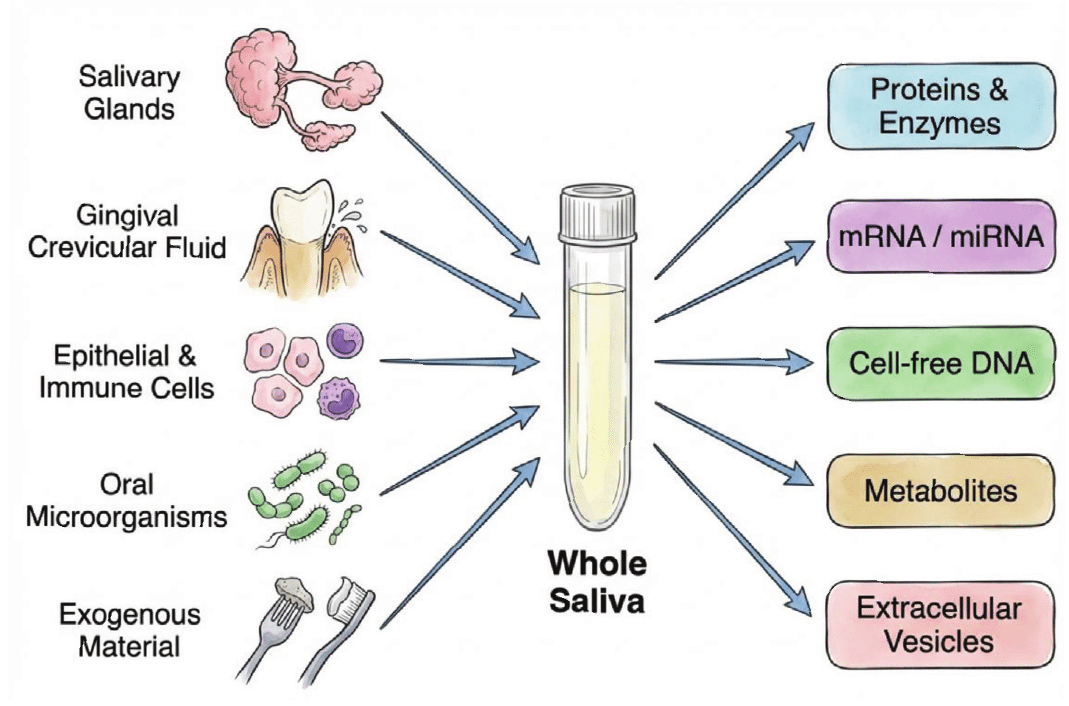
Saliva captures biology from multiple tissue compartments simultaneously, but pooling across the entire oral cavity dilutes site-specific signals and introduces confounders. Periodontal inflammation, for example, enriches saliva with GCF-derived proteases and cytokines even when the clinical question concerns caries or oral cancer.5
The process of sample collection affects the biomarkers found in saliva. Unstimulated saliva has been used to obtain most published biomarker cutoffs, while stimulated saliva changes can dilute low-abundance targets. Oral rinse and gargle specimens offer standardized volumes and are operationally attractive for multi-analyte workflows, but reference ranges validated in one matrix cannot be transferred to another without revalidation.6,7
For the clinician, saliva is best suited to patient-level screening, risk stratification, and longitudinal monitoring. When site-specific information is needed (eg, evaluating a small suspicious lesion), targeted swabs or crevicular fluid collection may outperform whole-mouth saliva for the same biomarker class.3,8
Pre-Analytic Considerations for the Dental Office
Pre-analytic variability is the dominant barrier to salivary biomarker reliability in clinical settings. Small changes in collection timing, patient preparation, and sample handling can shift measured concentrations enough to cross decision thresholds.9,10
Hydration status can affect saliva flow rate. Dehydration concentrates analytes and can produce falsely elevated readings. At minimum, standardize collection time of day, document recent fluid intake, and allow a brief rest period before sampling.11 Patient preparation should be standardized when logistically possible. For example, no food or beverages for at least 1 hour before collection, no smoking, coffee, or chewing gum in that window, and no toothbrushing or antiseptic mouthrinse immediately before sampling. Brushing and the use of antiseptic oral rinses can shift both protein profiles and the oral microbiome.12,13
Blood contamination is a recurrent confounder in oral-disease populations. Many analytes exist at concentrations orders of magnitude higher in blood than saliva, so even small amounts of gingival bleeding can bias results. Visibly contaminated samples should be discarded, and collection should be deferred during active bleeding or immediately after invasive procedures.14,15 Because within-person salivary analyte levels can vary meaningfully across days, repeat sampling is often the best safeguard for borderline or clinically discordant results.16
Omics Technologies From Biomarker Discovery to Targeted Assays
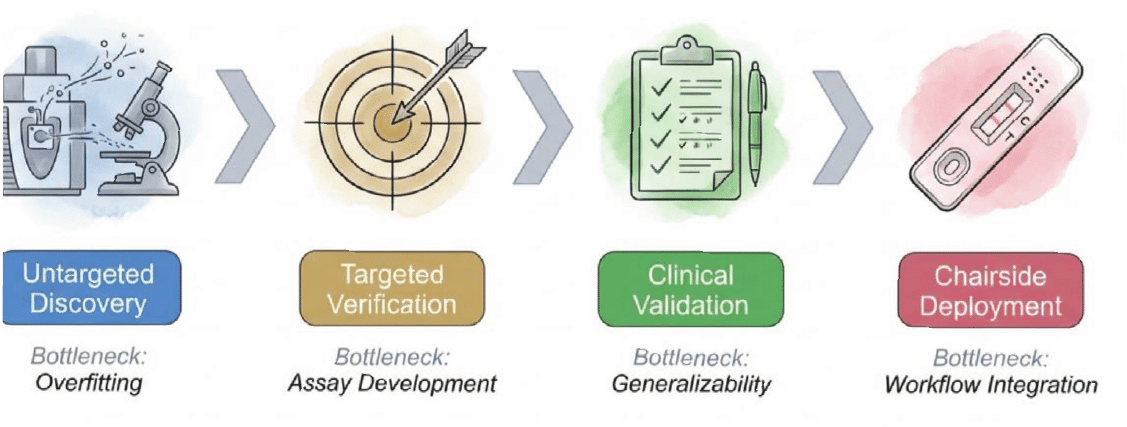
The term “omics” encompasses several measurement platforms, each capturing a different aspect of disease biology in saliva: proteomics (host-response proteins), transcriptomics (mRNA and miRNA), genomics/epigenomics (cell-free DNA, mutations, methylation), metabolomics, and microbiomics. Regardless of modality, clinical translation follows the same progression: untargeted discovery in small cohorts, targeted verification of a short candidate list, and clinical validation with prespecified cutoffs in the intended-use population (Figure 2).17
Proteomics is the most advanced technology in terms of readiness for periodontal applications. Active matrix metalloproteinase-8 (aMMP-8), which reflects active collagen breakdown in inflamed periodontal tissues, can now be measured by lateral-flow point-of-care (POC) tests. An updated validation and meta-analysis of 67 studies and 2,048 subjects reported moderate-to-high specificity with lower sensitivity, suggesting a role as a “rule-in” diagnostic rather than a stand-alone screening tool.18
For oral cancer, salivary miRNA panels show strong diagnostic performance. One study reported an eight-miRNA panel distinguishing oral squamous cell carcinoma from healthy controls with an area under the curve (AUC) near 0.95, and a four-miRNA panel separating oral cancer from oral potentially malignant disorders with AUC approximately 0.91.19 DNA methylation markers in oral rinse are also promising: a two-gene panel performed comparably to expert clinical examination for discriminating dysplasia or cancer from benign lesions.20
Microbiome profiling can detect dysbiosis patterns associated with both caries and periodontitis. However, between-study variability is substantial, and batch effects can strongly influence apparent signatures.21,22 Metabolomics studies consistently identify shifts in organic acids and microbial metabolites across oral health phenotypes, but diet, time-since-eating, and oral hygiene products can dominate the salivary metabolome and confound disease-associated signals.23
The key translational bottleneck across all modalities is generalizability. Panels must be validated across different populations, clinical sites, and coexisting inflammatory conditions before claims about diagnostic accuracy can be trusted.
Point-of-Care Technologies for Chairside Testing
POC salivary tests add clinical value when results change what happens at the visit: identifying who needs further workup or tracking treatment response over time. Lateral-flow immunoassays are the most practical chairside format. They are fast, inexpensive, and deployable without specialized equipment. Reader-assisted versions reduce operator subjectivity and produce semiquantitative results suitable for longitudinal follow-up of patients. The main limitations in saliva are matrix effects from viscosity and debris, which can produce weak lines or occasional test failures.24,25
Microfluidics represent a promising platform that could see clinical deployment in the near future. Proof-of-principle researched demonstrated microfluidic immunoassay measurement of salivary MMP-8 in under 10 minutes by integrating sample pretreatment on-chip.26 Automated conditioning within centrifugal cartridges has also reduced saliva viscosity tenfold while preserving biomarker measurements.27 For general dental offices, microfluidics will most likely arrive as closed, vendor-supported cartridges for specific high-value applications.
Molecular POC systems using technologies, such as isothermal amplification or CRISPR-based detection, are also attractive for high-specificity detection of microbial targets or tumor-derived nucleic acids. The bottleneck for those systems is sample preparation including lysis, inhibitor removal, contamination control, rather than detection chemistry, and these workflows are not yet practical for routine dental office use.28
For now, the strongest evidence supports POC salivary tests as adjuncts for identifying patients who need comprehensive consultation by a specialist and biomarker trend monitoring during maintenance care.
Disease-Specific Applications
Salivary caries markers function best as risk-context signals reflecting flow rate, buffering capacity, and microbial burden. They do not diagnose individual lesions. A systematic review found low overall evidence for single salivary tests and noted that mutans streptococci assays often show low sensitivity with higher specificity, consistent with confirming risk rather than excluding it.29 Studies on proteomics conclude that many proteins differ between caries-active and caries-free groups. However, no single marker is consistently discriminative.30
The category of periodontitis and peri-implant diseases has the most mature evidence. Host-response biomarkers (aMMP-8, IL-1β, hemoglobin) show reproducible salivary signals for periodontal inflammation. The oral-rinse aMMP-8 POC test demonstrates moderate-to-high specificity for detecting periodontitis, supporting its use as an adjunctive rule-in/triage tool alongside clinical probing and radiographs.18,31 Similar inflammatory pathways have been characterized in peri-implant crevicular fluid, though the evidence remains insufficient to claim reliable prediction of disease progression.32
Case-control studies of salivary cytokines and nucleic acid panels show encouraging discrimination between oral cancer and healthy controls. However, oral cancer has low prevalence in the general dental population, which means even a sensitive test will produce many false positives when applied as a broad screen.33 Positive predictive value improves substantially when testing is targeted to patients with clinically suspicious lesions or high-risk histories.34,35
| Disease | Strongest Analyte Classes | Plausible Use Today | Key Confounders | Validation Status |
|---|---|---|---|---|
| Dental caries | Salivary flow/buffering, mutans streptococci, metabolites | Adjunctive risk stratification; calibrate prevention intensity | Diet, oral hygiene, time-since-eating, circadian effects | Low overall evidence for single tests; no consistently discriminative single marker |
| Periodontitis, peri-implant disease | aMMP-8, IL-1β, hemoglobin, host-response proteins | Adjunctive rule-in/triage; treatment monitoring during maintenance | Smoking, diabetes, mixed gingivitis/ |
Most mature; aMMP-8 POC validated in meta-analysis (67 studies) |
| Oral cancer, Oral potentially malignant disorder |
miRNA panels, DNA methylation, salivary cytokines, cfDNA | Targeted triage of clinically suspicious lesions; risk stratification | Periodontal inflammation, low prevalence (false-positive burden), human papillomavirus status | Strong case-control signals; prospective validation and clinical utility studies needed |
| Salivary gland hypofunction | Sialometry (flow rate) | Trigger for intensified caries prevention and medication review | Medications, hydration, time of day | Well-established clinical thresholds (≤ 0.1 mL/min unstimulated) |
Summary of the current evidence base for salivary diagnostics across major oral diseases, including the strongest analyte classes, plausible clinical uses, key confounders, and validation status.
Evaluating Salivary Diagnostic Claims
As more salivary tests reach the market, clinicians will need to distinguish validated diagnostics from premature marketing. A practical framework for assessing these tools evaluates three levels of evidence: analytical validity, clinical validity, and clinical utility.36
First, analytical validity asks whether the test reliably measures the analyte in saliva. Clinicians should demand precision data at clinically relevant concentrations, a limit of quantitation (not just limit of detection), and interference testing that includes blood contamination and specific collection devices.37,38
Second, clinical validity asks whether the test works in the population where it will be used. Case-control studies that compare advanced cancer against cherry-picked healthy volunteers overestimate real-world performance. Stronger designs enroll consecutive patients from the intended-use setting, include mild and borderline cases, and report external validation across independent sites. Quality appraisal tools such as QUADAS-2 can help identify common sources of bias.39
Third, clinical utility asks whether using the test changes management in a way that benefits patients. Even a well-validated biomarker may lack utility if the result does not alter treatment decisions.
Key considerations and red flags when evaluating marketed tests include:
- No saliva-matrix analytical validation.
- Case-control-only evidence with cherry-picked healthy controls, thresholds selected after seeing the data, no external validation, and claims of population screening without analysis of positive predictive value.
- When regulatory status is unclear, review the intended use statement of the diagnostic if available and confirm whether the product is a United States Food and Drug Administration-cleared in vitro diagnostic or a laboratory-developed test.40
Conclusion
Saliva offers a scalable, noninvasive route to biological information that complements clinical examination. Among current applications, salivary and oral-rinse markers of periodontal tissue breakdown have the strongest supporting evidence as adjunctive tools for triage and treatment monitoring.18 For caries and oral cancer, promising biomarkers and multi-omics panels exist, but standardization, prospective validation, and demonstration of clinical utility remain in progress.
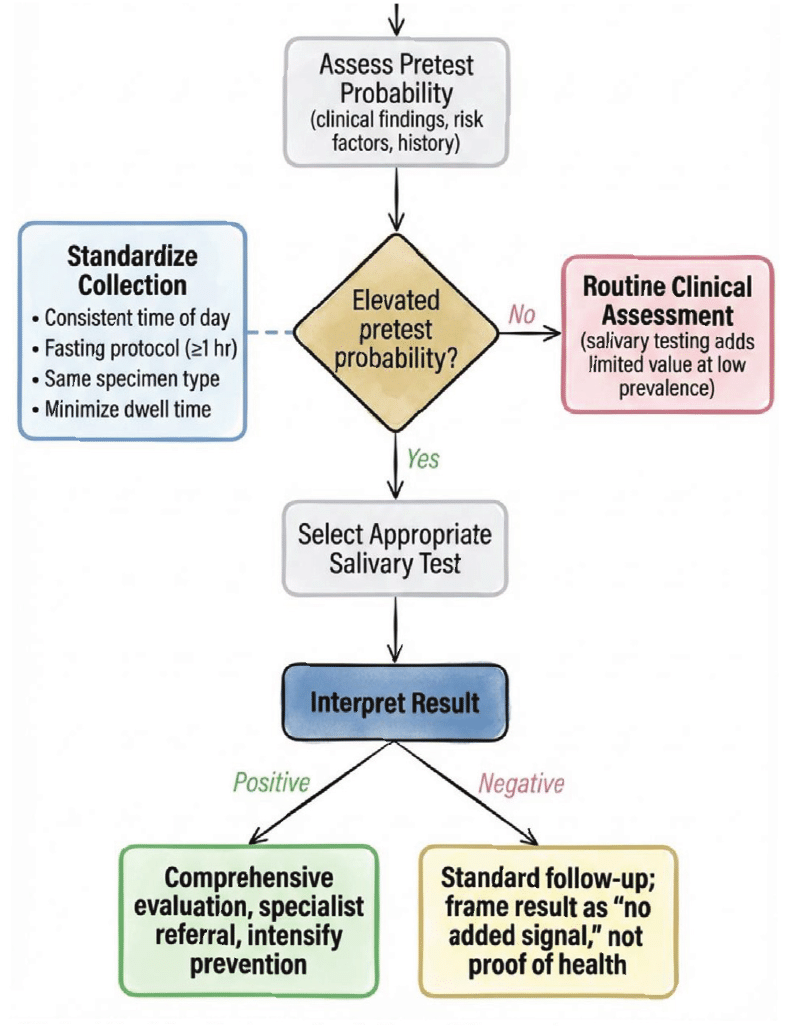
Clinicians should treat salivary test results as one input in a broader risk assessment, standardize collection protocols when using tests longitudinally, and demand evidence that any test has been validated analytically and clinically in the relevant patient population (Figure 3). The field will advance most effectively through disciplined translation: consistent pre-analytics, transparent reporting, and practice-based studies that show whether testing improves outcomes rather than simply detects analytes.
References
- Buzalaf MAR, Ortiz AC, Carvalho TS, et al. Saliva as a diagnostic tool for dental caries, periodontal disease and cancer: is there a need for more biomarkers? Expert Rev Mol Diagn. 2020;20:543–555.
- Pfaffe T, Cooper-White J, Beyerlein P, Kostner K, Punyadeera C. Diagnostic potential of saliva: current state and future applications. Clin Chem. 2011;57:675–687.
- Proctor GB. The physiology of salivary secretion. Periodontol 2000. 2016;70:11–25.
- Helmerhorst EJ, Dawes C. The complexity of oral physiology and its impact on salivary diagnostics. Oral Dis. 2018;24:1434–1441.
- Ramenzoni LL, Hofer D, Solderer A, et al. Origin of MMP-8 and lactoferrin levels from gingival crevicular fluid, salivary glands and whole saliva. BMC Oral Health. 2021;21:385.
- Fan X, Peters BA, Jacobs EJ, et al. Comparison of the oral microbiome in mouthwash and whole saliva samples. PLoS ONE. 2018;13:e0194729.
- Lim Y, Totsika M, Morrison M, Punyadeera C. The saliva microbiome profiles are minimally affected by collection method or DNA extraction protocols. Sci Rep. 2017;7:8523.
- Wren ME, Shirtcliff EA, Drury SS. Not all biofluids are created equal: chewing over salivary diagnostics and the epigenome. Clin Ther. 2015;37:529–539.
- Ng TKS, Slowey PD, Beltran D, et al. Guidelines for standardization of pre-analytical variables for salivary biomarker studies: updated consensus. Alzheimers Dement. 2025;21:e14420.
- Batool SM, Hsia T, Khanafer S, et al. Extrinsic and intrinsic preanalytical variables affecting liquid biopsy in cancer. Cell Rep Med. 2023;4:101196.
- Walsh NP, Laing SJ, Oliver SJ, Montague JC, Walters R, Bilzon JL. Saliva parameters as potential indices of hydration status during acute dehydration. Med Sci Sports Exerc. 2004;36:1535–1542.
- Justino AB, Teixeira RR, Peixoto LG, Jacomini M, Queiroz JH, Espindola FS. Effect of saliva collection methods and oral hygiene on salivary biomarkers. Scand J Clin Lab Invest. 2017;77:415–422.
- Chatzigiannidou I, Teughels W, Van de Wiele T, Rodzlan Hasnan NA. Oral biofilms exposure to chlorhexidine results in altered microbial composition and metabolic profile. Sci Rep. 2020;10:17123.
- Kamodyová N, Tóthová L, Celec P. Salivary markers of oxidative stress and antioxidant status: influence of external factors. Dis Markers. 2015;2015:479251.
- Kang JH, Kho HS. Blood contamination in salivary diagnostics: current methods and their limitations. Clin Chem Lab Med. 2019;57:1115–1124.
- Thomas MV, Branscum A, Miller CS, et al. Within-subject variability in repeated measures of salivary analytes in healthy adults. J Periodontol. 2009;80:1146–1153.
- Cirillo N. A roadmap for the rational use of biomarkers in oral disease screening. Biomolecules. 2024;14:787.
- Lai HC, Kung JCK, Shi J, et al. Diagnostic accuracy of a point-of-care aMMP-8 test for discriminating periodontal health status in adults: validation trials and updated meta-analysis. J Clin Periodontol. 2025;52:510–529.
- Balakittnen J, Weeramange CE, Wallace DF, et al. A novel saliva-based miRNA profile to diagnose and predict oral cancer. Int J Oral Sci. 2024;16:14.
- Schussel J, Zhou XC, Zhang Z, et al. EDNRB and DCC salivary rinse hypermethylation has a similar performance as expert clinical examination in discrimination of oral cancer/dysplasia versus benign lesions. Clin Cancer Res. 2013;19:3268–3275.
- Dong X, Lin Y, Zhang H, et al. Diagnostic accuracy of microbiome-derived biomarkers in periodontitis: systematic review and meta-analysis. J Periodontal Res. 2025;60:e13377.
- Regueira-Iglesias A, Suárez-Rodríguez B, Blanco-Pintos T, et al. The salivary microbiome as a diagnostic biomarker of periodontitis: a 16S multi-batch study before and after the removal of batch effects. Front Cell Infect Microbiol. 2024;14:1405699.
- Baima G, Iaderosa G, Citterio F, et al. Salivary metabolomics for the diagnosis of periodontal diseases: a systematic review with methodological quality assessment. Metabolomics. 2021;17:1.
- Johnson N, Ebersole JL, Kryscio RJ, Danaher RJ, Dawson D, Al-Sabbagh M, Miller CS. Rapid assessment of salivary MMP-8 and periodontal disease using lateral flow immunoassay. Oral Dis. 2016;22:681–687.
- Faulstich K, Gruler R, Eberhard M, Lentzsch D, Haberstroh K. Handheld and portable reader devices for lateral flow immunoassays. In: Wong R, Tse H, eds. Lateral Flow Immunoassay. Totowa, New Jersey: Humana Press; 2009.
- Herr AE, Hatch AV, Throckmorton DJ, et al. Microfluidic immunoassays as rapid saliva-based clinical diagnostics. Proc Natl Acad Sci U S A. 2007;104:5268–5273.
- Johannsen B, Müller L, Juelg P, et al. Automated pre-analytic processing of whole saliva using magnet-beating for point-of-care protein biomarker analysis. Micromachines. 2019;10:833.
- Ghouneimy A, Mahas A, Marsic T, Aman R, Mahfouz M. CRISPR-based diagnostics: challenges and potential solutions toward point-of-care applications. ACS Synth Biol. 2023;12:1–16.
- Senneby A, Mejàre I, Sahlin NE, Svensäter G, Rohlin M. Diagnostic accuracy of different caries risk assessment methods: a systematic review. J Dent. 2015;43:1385–1393.
- Ahmad P, Hussain A, Carrasco-Labra A, Siqueira WL. Salivary proteins as dental caries biomarkers: a systematic review. Caries Res. 2022;56:385–398.
- Sorsa T, Sahni V, Buduneli N, et al. Active matrix metalloproteinase-8 (aMMP-8) point-of-care test (POCT) in the COVID-19 pandemic. Expert Rev Proteomics. 2021;18:707–717.
- Alassy H, Parachuru P, Wolff L. Peri-implantitis diagnosis and prognosis using biomarkers in peri-implant crevicular fluid: a narrative review. Diagnostics. 2019;9:214.
- Balevi B. Assessing the usefulness of three adjunctive diagnostic devices for oral cancer screening: a probabilistic approach. Community Dent Oral Epidemiol. 2011;39:171–176.
- Huang L, Guo T, Zeng K, et al. The relationship between salivary cytokines and oral cancer and their diagnostic accuracy: a systematic review and network meta-analysis. BMC Oral Health. 2024;24:1048.
- Lingen MW. The promise and potential peril of at-home oral cancer testing. Oral Surg Oral Med Oral Pathol Oral Radiol. 2023;135:1–2.
- Hayes DF. Defining clinical utility of tumor biomarker tests: a clinician’s viewpoint. J Clin Oncol. 2021;39:238–248.
- Jaedicke KM, Taylor JJ, Preshaw PM. Validation and quality control of ELISAs for the use with human saliva samples. J Immunol Methods. 2012;377:62–65.
- Burd EM. Validation of laboratory-developed molecular assays for infectious diseases. Clin Microbiol Rev. 2010;23:550–576.
- Whiting PF, Rutjes AWS, Westwood ME, et al. QUADAS-2: a revised tool for the quality assessment of diagnostic accuracy studies. Ann Intern Med. 2011;155:529–536.
- Huber MA, Epstein JB. Marketing versus science: a call for evidence-based advertising in dentistry. Oral Surg Oral Med Oral Pathol Oral Radiol. 2015;120:541–543.
From Decisions in Dentistry. November/December 2026;12(3):32–35.