



Google Doesn’t Trust You Yet: The Real Reason Your Dental SEO Feels Stuck
Wondering why your dental SEO isn’t working yet? Discover how Google evaluates trust, authority, and ranking signals before rewarding your practice with top rankings.
What You’ll Learn
- Why Google intentionally moves slowly when rewarding websites with higher rankings, and what that means for your practice’s long-term online visibility.
- How backlinks, content quality, and user behavior all work together as “trust signals” that Google uses to decide who deserves the top spots in search results.
- Why dental SEO compounds over time like interest in a savings account, and what you can do right now to start building a foundation that pays off for years.
Here’s a scenario that might feel familiar.
You built a great dental website. Your team spent hours choosing the right photos, writing up your services, and making sure your contact info was easy to find. You maybe even hired someone to help with SEO. And then… nothing much happened. Weeks went by… then months. Your Google ranking barely budged, and new patient calls from search were disappointingly quiet.
So you start to wonder: Is SEO even real? Does it actually work?
Short answer: Yes. Completely.
But here’s the thing nobody tells you upfront. Google doesn’t hand out rankings like a welcome basket when you move into the neighborhood. It watches. It waits. It tests. And it only starts rewarding your site after it has gathered enough evidence that you deserve to be trusted.
This isn’t a bug in the system. It’s the whole point.
Why Google Moves Slowly on Purpose
Think about it from Google’s perspective. If they rewarded every new website with immediate top rankings, every spammer on the internet would build a quick site, flood it with keywords, and show up in front of patients searching for their next dentist. That would make Google’s search results useless, and patients would stop trusting them.
So instead, Google built a system designed to resist manipulation. Time is the filter that separates the legitimate practices from the shortcuts. If you’ve been frustrated by how slow dental SEO feels, you’re actually experiencing the system working exactly as intended.
The question isn’t how to trick it. The question is how to earn it.
Step One: Google Has to Find You First (Crawling and Indexing)
Before Google can rank you, it has to know you exist. It does this through a process called crawling, where automated programs called “bots” or “spiders” travel across the internet following links from site to site, reading every page they land on.
Once they’ve read your pages, they store that information in a massive index, essentially a library of billions of web pages. When someone searches “family dentist near me,” Google pulls from that index and decides which pages are the most relevant and trustworthy.
Here’s the catch: being indexed doesn’t mean being ranked. It just means you’re in the library. Getting to the front of the library, where patients actually find you, requires a lot more.
Step Two: Google Evaluates Your Content Quality
Once Google finds your website, it starts asking a very important question: Is this content actually helpful?
Google’s algorithms are remarkably good at detecting thin, generic, or repetitive content. If your service pages all sound like they were copy-pasted from a template (and a lot of dental websites do), Google notices and is not impressed.
What Google responds to is depth, specificity, and genuine usefulness. A page on dental implants that actually explains the process, answers common patient questions, and uses language that real patients use will always outperform a paragraph stuffed with keywords.
This is also why blogging matters more than most practice owners realize. Regularly publishing helpful, relevant content tells Google that your site is alive and active, not a digital ghost town. It gives the algorithms more material to evaluate, more opportunities to trust you, and more ways to match your practice with the specific questions your future patients are typing into the search bar.
Even Google’s newer AI-powered features now pull from practices with established content authority, which means content quality has become even more critical in 2026 than it was just a few years ago.
Step Three: Backlinks Are the Internet’s Version of a Word-of-Mouth Referral
Here’s a concept that clicks immediately for most dentists: word-of-mouth.
When a patient sends their neighbor to your practice because they had a great experience, that referral carries serious weight. It’s an endorsement from a trusted source.
Backlinks work the same way, except it’s websites doing the endorsing instead of people. When another reputable website links to your practice’s website, that’s essentially an online vote of confidence. It says, “This site is worth visiting. It has something valuable to offer.”
The more high-quality backlinks you have, the more Google sees your site as an authority in your field. But notice that word: high-quality. Not every backlink is equal. A link from a well-known dental journal means something very different to Google than a link from a sketchy directory no one’s ever heard of.
Building a strong backlink profile takes time because it requires earning trust from others first. You need to create content worth linking to, build relationships with local organizations and professional associations, and publish helpful information that other sites naturally want to reference. There’s no shortcut that holds up long-term, and Google’s systems are sophisticated enough to penalize sites that try to buy their way to the top.
For a deeper look at how dental reputation management and online authority intersect, it’s worth exploring how reviews and citations also contribute to your overall trust profile.
Step Four: Google Watches How Real Patients Behave on Your Site
This one surprises a lot of practice owners.
Google doesn’t just look at your website in isolation. It also pays close attention to how people interact with it. Two signals in particular carry significant weight: click-through rate (CTR) and dwell time.
Click-through rate is the percentage of people who see your practice in the search results and actually click on it. If Google shows your listing to 100 people and only two click through, that tells them something is off, maybe your title or description isn’t compelling, or you’re showing up for the wrong searches.
Dwell time is how long someone stays on your site after clicking. If a potential patient clicks your link, spends eight seconds on the page, and immediately hits the back button to look at a competitor, that’s a red flag. Google reads that as: “This site didn’t give them what they were looking for.”
On the flip side, when patients land on your site and actually stick around, read your content, explore your service pages, or book an appointment, Google takes note. This kind of positive user behavior is one of the signals that gradually moves the needle in your favor.
This is why your dental website design matters far beyond aesthetics. A website that loads quickly, looks professional, and makes it easy for patients to find what they need will naturally keep visitors engaged longer, which sends exactly the right signals to Google.
Step Five: Google Tests You Before It Rewards You
Here’s something even most marketing professionals don’t explain clearly: Google doesn’t flip a switch and suddenly promote a site. It runs experiments.
When you make improvements to your website or publish new content, Google might temporarily boost your ranking to see what happens. If more people click your listing and engage with your site, great. If the bounce rate spikes and people leave immediately, Google pulls back. Over time, through dozens of these micro-tests, Google develops a more confident picture of where you belong in the rankings.
This testing process can take months, sometimes longer in competitive markets. SEO for dentists requires patience and consistency precisely because Google’s evaluation cycles are ongoing, not one-time events.
Why Competition Changes Everything
There’s one more factor that most dental SEO conversations skip over: your competitors have a head start.
If the top-ranking dental practice in your city has been building their online presence for five years, they have five years of content, backlinks, positive user signals, and algorithmic trust that you simply can’t replicate in five weeks. That doesn’t mean you can’t outrank them eventually, but it does mean that the timeline is realistic, not overnight.
The good news? Competition cuts both ways. Practices in smaller markets or underserved communities often find it much easier to rank quickly because the bar is lower. And even in competitive markets, consistent effort compounds over time.
SEO Compounds Like Interest, Not Like Ads
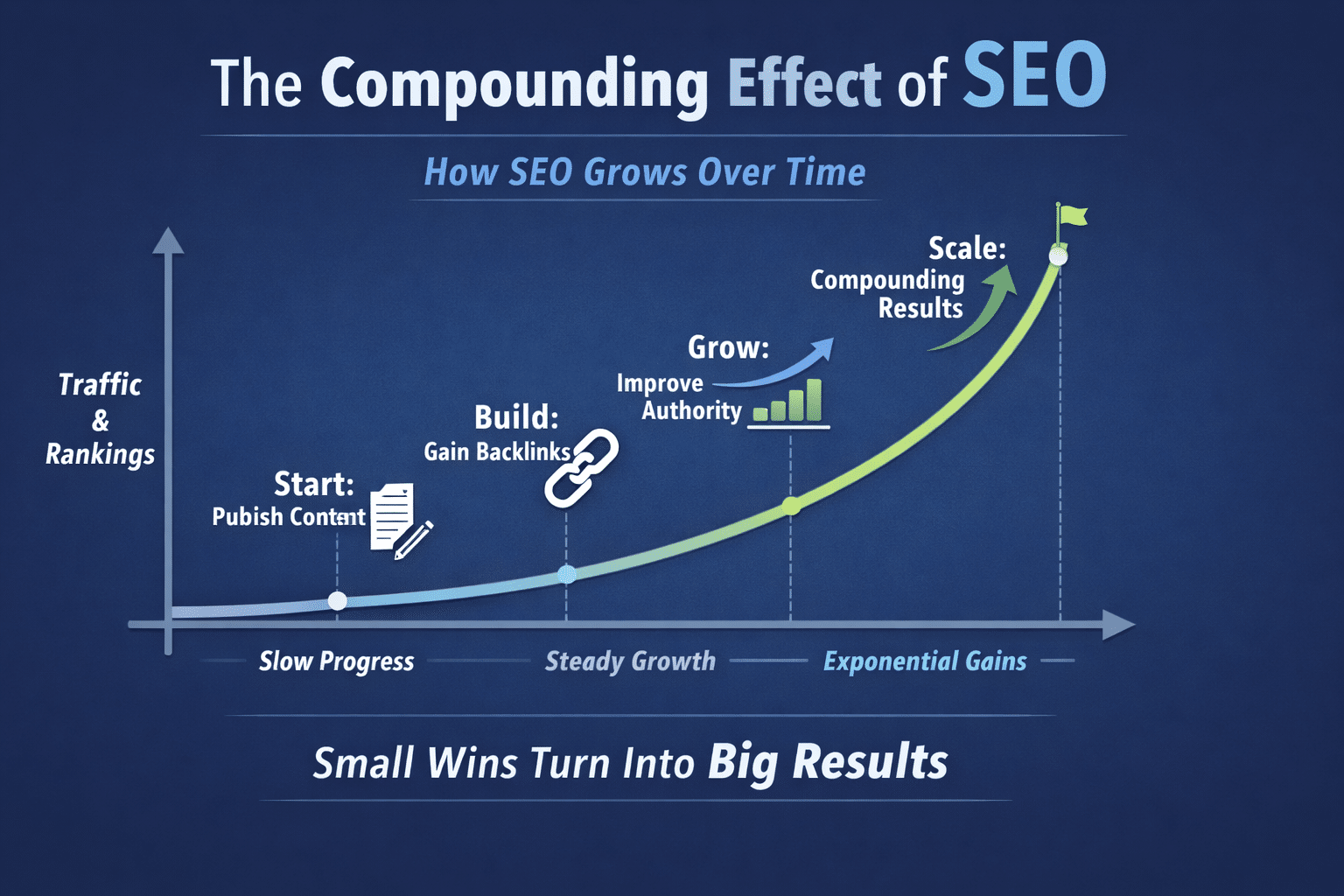
This might be the most useful mental model for understanding dental SEO: it grows like interest, not like an ad.
When you run a paid advertising campaign, you get visibility the moment you start paying, and you lose it the moment you stop. The traffic tap turns on and off with your budget.
SEO works differently. The content you publish today can attract patients next month, next year, and three years from now. The backlinks you earn this quarter build on each other. The trust you establish with Google creates a foundation that becomes progressively harder for competitors to displace.
| Marketing Channel | Speed of Results | Longevity | Cost Over Time |
| Google Ads (PPC) | Immediate | Stops when budget stops | Ongoing spend required |
| Social Media Ads | Fast (days) | Short-term | Ongoing spend required |
| Organic Dental SEO | Slow (months) | Long-term and compounding | Decreases as authority builds |
| Local SEO / Google Maps | Moderate | Durable with maintenance | Moderate ongoing effort |
As you can see, SEO for dentists requires an upfront investment of time and consistency. But the long-term return is something paid advertising simply can’t replicate.
For practices looking to complement their organic efforts while SEO builds momentum, dental paid advertising can fill the gap in the short term. But it’s the organic foundation that builds lasting, compounding visibility.
What You Can Start Doing Right Now
You don’t have to wait passively while Google decides whether to trust you. There are concrete actions you can take to accelerate the process:
- Audit your existing content. Are your service pages thorough and helpful, or are they thin and generic? Rewriting shallow pages with more depth signals immediately to Google that your site is improving.
- Start publishing blog content consistently. Even one quality post per month adds up significantly over a year. Understanding how patients actually search for dental care will help you write content that matches their real questions.
- Build your local reputation. Getting more Google reviews, earning directory citations, and being mentioned by local businesses and organizations all contribute to the trust signals Google uses when evaluating your practice.
- Improve your website’s technical performance. A slow website, or one that doesn’t work well on mobile devices, will send negative user behavior signals no matter how good your content is.
And if you want to understand how AI is already reshaping this landscape, the intersection of AI and dental SEO is worth getting familiar with now, before your competitors do.
Conclusion
SEO isn’t broken, and Google isn’t ignoring you. The system is working exactly as it’s designed to: slowly, deliberately, and in favor of practices that show up consistently and genuinely serve their patients online. Every piece of content you publish, every backlink you earn, and every positive patient experience that keeps someone on your website longer is quietly building the trust that Google rewards over time. Start now, stay consistent, and let the compounding effect work in your favor.
Frequently Asked Questions
Q: Why does Google care how long someone stays on my website? A: Dwell time is one of the behavioral signals Google uses to evaluate whether your content actually satisfies what patients were looking for. When visitors stay longer and explore your site, it tells Google that your practice is a good match for their search, which can gradually improve your ranking over time.
Q: Can I speed up dental SEO by paying Google? A: Paying Google through Google Ads (PPC) can get you immediate visibility at the top of search results, but that visibility disappears the moment you stop paying. Organic SEO, by contrast, builds a lasting presence that doesn’t vanish when the budget runs out. The two strategies work best together, especially in the early stages.
Q: How does competition in my area affect how quickly my SEO works? A: If other dental practices in your market have been building their online presence for years, they have a significant head start in terms of backlinks, content, and algorithmic trust. You can absolutely outrank them over time, but it requires a sustained effort. In less competitive markets, practices often see results much faster because the ranking bar is lower.