
Can Arginine Help Turn the Tide on Global Caries?
Emerging evidence suggests arginine, alone and alongside fluoride, may offer a powerful new strategy to reduce caries worldwide.
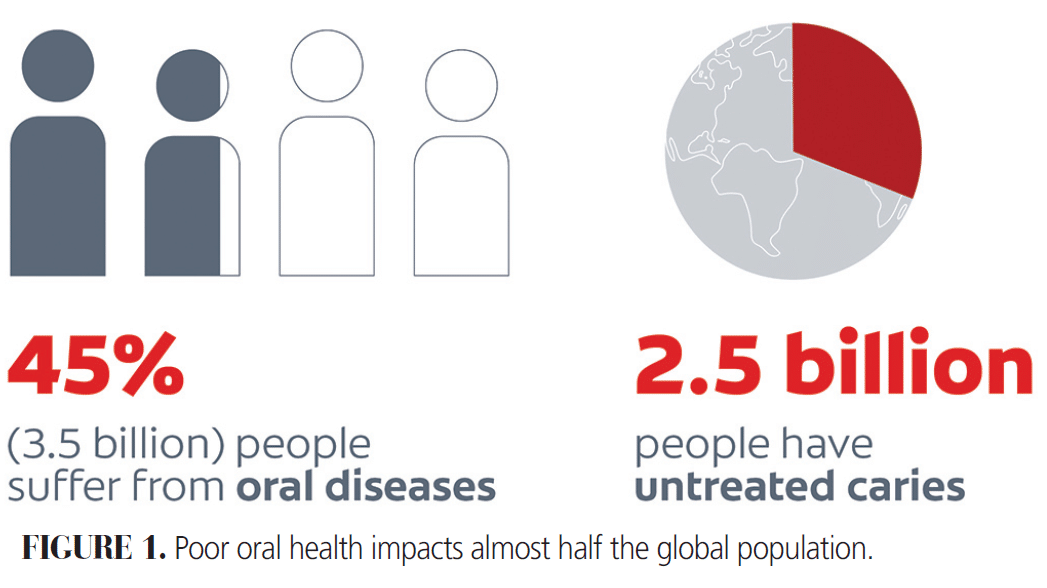
Almost half of the world’s population — 3.5 billion people — suffers from oral diseases. The most prevalent of which is caries, which impacts more than 2.5 billion people globally and is the most common chronic disease in children (Figure 1). Over the past 30 years, the number of caries cases in permanent teeth increased by 640 million, primarily driven by population growth and increased sugar consumption in low- and lower-middle-income countries. This reflects a persistent disparity: individuals of lower socioeconomic status experience oral diseases more frequently and with greater severity.1
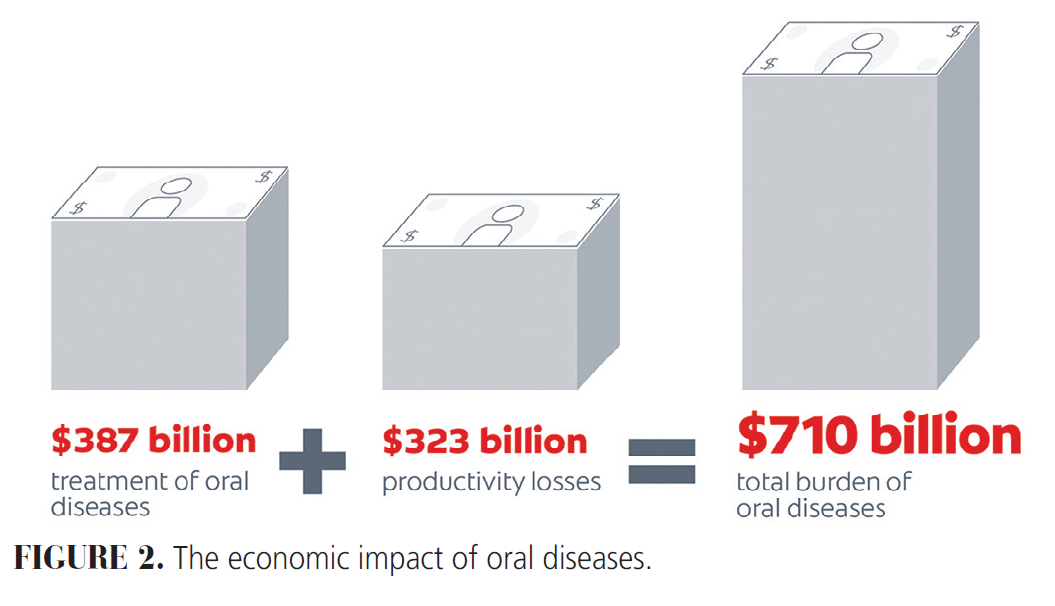
Untreated oral diseases create a considerable economic burden, stemming from both high treatment costs and losses in workforce productivity. In 2019, a representative sample of 194 countries spent $387 billion to treat oral diseases, while losing $323 billion in productivity, a total cost of $710 billion (Figure 2).2 Oral diseases can also impact overall health and well-being, contributing to rising healthcare costs.
The magnitude of the economic costs, along with a sharp decline in the quality of life for people with caries, demands innovative solutions. Today, fluoride remains the consensus choice for caries prevention. Results from over 70 global clinical studies conclude that fluoride reduces decayed, missing, and filled tooth surfaces (DMFS) by 24% in children.3 A meta-review of 40 studies reported that fluoride, either from dentifrice or water supplementation, prevents 29% of caries on the tooth crown and 22% of caries on the root surface.4
Arginine is an oral prebiotic that increases the pH of biofilms and the oral environment when metabolized by oral bacteria (Figure 3), whereas fluoride acts directly on the tooth surface to strengthen enamel and promote remineralization.5 A naturally occurring semi-essential amino acid, arginine is found in many foods such as meats, dairy products, and even in breast milk.
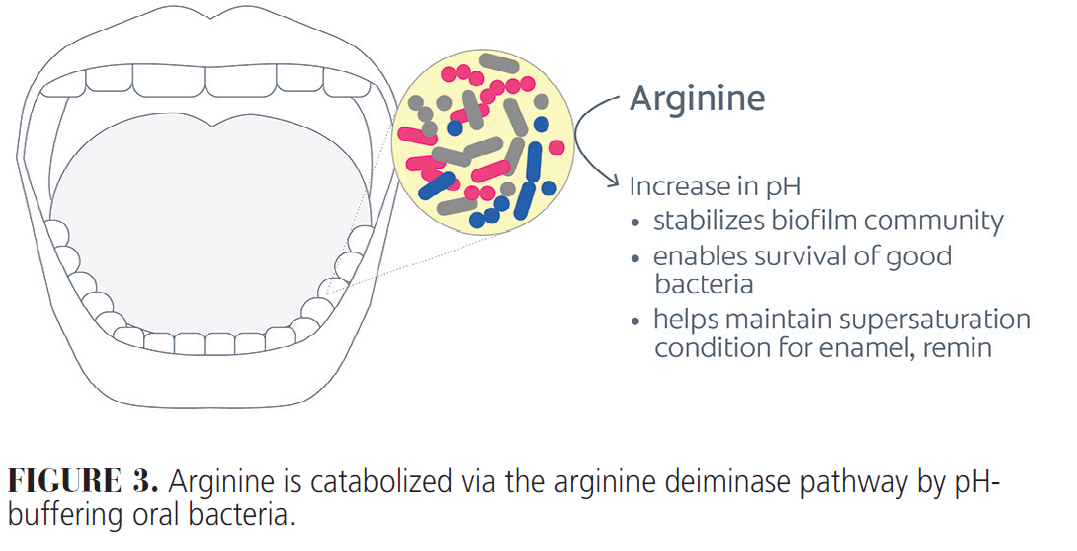
Arginine’s potential as an anticaries agent was first recognized in the 1980s. Early work found that the pH of dental plaque varied based on the proportion of arginolytic bacteria present. This pH-modulating effect was later linked to ammonia production by oral bacteria during arginine metabolism. This process increases the buffering capacity of saliva, and may increase the ammonia-producing capacity of the oral microbiome, generally.6
The first clinical study of arginine’s effectiveness as an anti-caries agent was conducted in Venezuela in the early 2000s. In this study, adolescents used an arginine dentifrice over 2 years. Arginine supplementation was associated with a significant decrease in the mean DMFS score.7 A subsequent study using arginine mints as a supplement over a 1-year period also reported a significant decrease in the DMFS score.8
Numerous studies conducted combining fluoride and arginine (1.5%) have demonstrated the additive effect of these two caries preventive agents in enhancing remineralization and in reducing early carious lesions. Research shows this dual intervention leads to a 50% reduction in early carious lesion size9,10 and up to 20% less new cavities as measured by decayed, missing, and filled teeth (DMFT) vs fluoride toothpaste after 2 years of use.11,12
The results of a recent 2-year clinical trial in China among 6,000 children, aged 10-14, across three centers, comparing two concentrations of arginine (1.5% and 8%) dentifrice with a 1,450 ppm sodium fluoride (NaF) control, identified a dose-response relationship between arginine and caries reduction. Compared to the NaF control, the 8% arginine dentifrice significantly reduced DMFS scores by 26%, and DMFT scores by 25.3% at 2 years. DMFS and DMFT scores for the lower arginine concentration (1.5%) were not statistically different from those of the NaF control group at 2 years.13
A recent 1-year phase 2 clinical trial in the US confirmed the efficacy of arginine. The trial enrolled 2,025 children, aged 10-14, across nine centers. Three arginine concentrations, 1.5%, 4%, or 8.0% were tested. A control group used a 0.24% (1,100 ppm) sodium fluoride dentifrice without arginine. A consistent decreasing dose-response trend in incremental DMFS and DMFT occurred over the study period, but it was not statistically significant. DMFS and DMFT increments were most favorable for the 1.5% arginine dentifrice, followed by the 4% dentifrice, and then the 8% dentifrice.
The contrasting results between the arginine alone vs fluoride trials are likely driven by differences in study design. The power of the studies was vastly different with approximately 2,000 subjects per group in the China study vs 500 subjects per group in the US study.
Central to these differences are the study duration and baseline caries experience; the China trial spanned 2 years with a lower disease burden (DMFS < 1), while the phase 2 US trial was a shorter, 1-year study involving participants with more advanced baseline disease (DMFS < 2). These discrepancies in length and initial severity can significantly alter the sensitivity of a trial to detect differences in treatment efficacy.
While other methodological variations like center count and pandemic recruitment strategies occurred, the interaction between study length and disease experience remains the most probable explanation for the differing results.
Fluoride alone has not eliminated tooth decay. Therefore, new and innovative evidence-based caries preventive actives must be identified that can complement the work that has been done solely by fluoride over the past 50 plus years. There are very few complex chronic diseases like caries that are managed by a single approach.
Fluoride and arginine have different mechanisms of action that can help to address the global burden of caries along with lifestyle changes that reduce sugar consumption and emphasize the importance of self-care in the management of caries. Arginine dentifrices alone or in conjunction with fluoride could offer novel approaches to reduce the caries economic burden while improving the quality of life for everyone.
Contact
Colgate Palmolive
https://www.colgatepalmolive.com/en-us/contact-us
800-468-6502
Acknowledgments
I would like to express my gratitude to the numerous investigators involved in the US clinical trial along with their dedicated staff members: Benett Amaechi, Domenick Zero, Marcelle Nascimento, Augusto Elias-Boneta, Violet Haraszthy, Meelin Dian Chin Kit-Wells, Yiming Li, David Hershkowitz, Hatice Hasturk, Raffi Miller, Andrea Zandona, Mabi Singh, and Gerard Kugel. I would also like to acknowledge the statistician for the US Phase 2 study, Howard Proskin, and the hardworking members of the R&D, clinical and regulatory teams at Colgate-Palmolive. Finally, I would like to thank Erin Kello for summarizing the clinical evidence used in the preparation of this clinical insights article.
References
- World Health Organization. Global Oral Health Status Report: Towards Universal Health Coverage for Oral Health by 2030. Available at who.int/publications/i/item/9789240061484. Accessed February 18, 2026.
- World Economic Forum. The Economic Rationale for a Global Commitment to Invest in Oral Health. Available at https://www.weforum.org/publications/the-economic-rationale-for-a-global-commitment-to-invest-in-oral-health/. Accessed February 18, 2026.
- Marinho VC, Higgins JP, Sheiham A, Logan S. Fluoride toothpastes for preventing dental caries in children and adolescents. Cochrane Database Syst Rev. 2003;2003:CD002278.
- Griffin SO, Regnier E, Griffin PM, Huntley V. Effectiveness of fluoride in preventing caries in adults. J Dent Res. 2007;86:410-415.
- Nascimento MM, Alvarez AJ, Huang X, et al. Metabolic profile of supragingival plaque exposed to arginine and fluoride. J Dent Res. 2019;98:1245-1252.
- Burne RA. Anti-caries mechanisms of action of arginine. In: Arginine and the Healthy Oral Microbiome. Proceedings from a Colgate Symposium: Arginine–A Breakthrough Technology Fighting the Caries Epidemic. Available at https://pages.ada.org/jadaplus_arginine/anti-caries-mechanisms-of-action-of-arginine. Accessed February 18, 2026.
- Acevedo AM, Machado D, Rivera LE, Wolff M, Kleinberg I. The inhibitory effect of an arginine bicarbonate/calcium carbonate (CaviStat®)-containing dentifrice on the development of dental caries in Venezuelan school children. J Clin Dent. 2005;16:63-70.
- Acevedo AM, Montero M, Rojas-Sanchez F, et al. Clinical evaluation of the ability of CaviStat in a mint confection to inhibit the development of dental caries in children. J Clin Dent. 2008;19:1-8.
- Yin W, Hu DY, Li X, et al. The anti-caries efficacy of a dentifrice containing 1.5% arginine and 1450 ppm fluoride as sodium monofluorophosphate assessed using Quantitative Light-induced Fluorescence (QLF). J Dent. 2013;41(Suppl 2):S22-28.
- Yin W, Hu DY, Fan X, et al. A clinical investigation using quantitative light-induced fluorescence (QLF) of the anticaries efficacy of a dentifrice containing 1.5% arginine and 1450 ppm fluoride as sodium monofluorophosphate. J Clin Dent. 2013;24(Spec no A):A15-22.
- Li X, Zhong Y, Jiang X, et al. Randomized clinical trial of the efficacy of dentifrices containing 1.5% arginine, an insoluble calcium compound and 1450 ppm fluoride over two years. J Clin Dent. 2015;26:7-12.
- Kraivaphan P, Amornchat C, Triratana T, et al. Two-year caries clinical study of the efficacy of novel dentifrices containing 1.5% arginine, an insoluble calcium compound and 1,450 ppm fluoride. Caries Res. 2013;47(6):582-590.
- Yin W, Zhou Z, Huang RZ, et al. Arginine dentifrices and childhood caries prevention: a randomized clinical trial. JDR Clin Trans Res. 2025:23800844251361471.
From Decisions in Dentistry. February/March 2026;12(1):24-25.